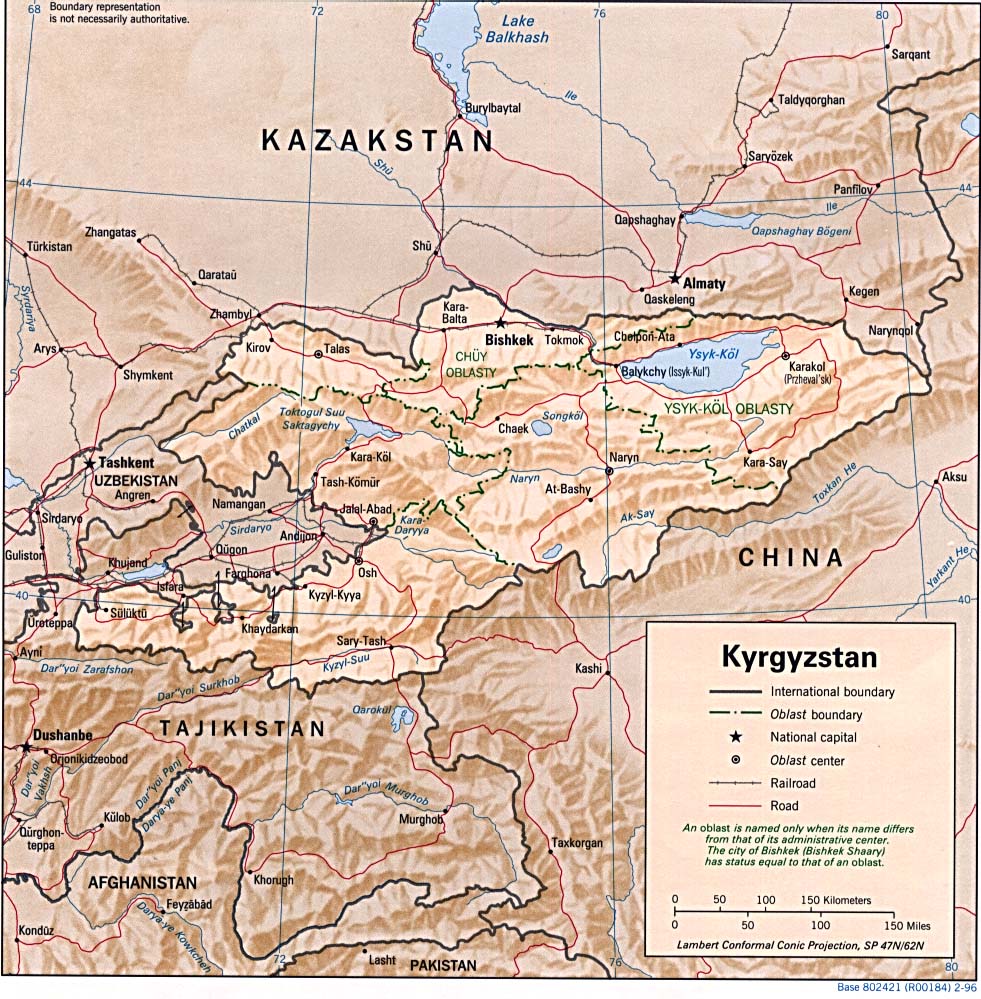
The emergence of Kyrgyzstan as a country ‘at the hub of superpower plans’ challenges the most determined geographer.
It can only be a matter of days before The Sun runs a piece entitled Ten Things you never knew about Kyrgyzstan. And if it does, for once there will be a point to the list: for this is a country that escaped even the notice of Sacha Baron Cohen.
Hands up all those who know what the national flag of Kyrgyzstan is. I thought so. Actually, it has a baseball in the middle, surrounded by sun-like marks on a red background. There are forty of these ray-style lines surrounding the baseball, and each one stands for a tribe that stood up to Genghis Khan in order to gain Kyrgyzstan’s independence. (Genghis Khan is another of those Asian names, by the way, that is these days spelt differently: the old pillaging ravager is now written as Chingiz Kan. And if anyone can, Chingiz Kan. It doesn’t do to argue with his sort.)
Instead of being something the Europeans and the Russians can argue about, the country is something the Chinese and Russians would’ve been arguing about for centuries – if only they’d known where the hell it is. But in these days of spy satellites that can photograph a tribal chief’s moustache from 3000 miles out in space, it has suddenly come to the attention of the World Powers. So in 2010, the Chinese, Russians and Americans can all have a barney about it.
It seems that on 3 February last year, President Kurmanbek Bakiyev announced the imminent closure of the Manas Air Base, the only US military base remaining in Central Asia. The closure was approved by Parliament on 19 February 2009 by 78 votes to 1,which isn’t what you’d call a narrow squeak. However, after behind-the-scenes negotiation between Kyrgyz (the adjective describing the state of being a Kyrgyzstan citizen) Russian and American diplomats, the decision was reversed in June. The American base was thus allowed to remain under a new contract.
My first inkling of Kyrgyzstan’s existence was when I learned that clashes there had escalated; so it was clear from the kick-off I had quite a learning curve to climb, given that until then I’d no idea what the citizens might be clashing about – or indeed, any awareness of anything that might cause Kyrgyz clashes in the first place. I was, clearly, a clash test dummy.
Channel Four informed me that the clashes were between police and protesters, but let’s face it, this isn’t an unusual combination. Gradually I gleaned that President Bakiyev has had five years to sack his own family, and signally failed. Coming to power on a family-firing ticket is extremely unusual, and probably has within it the seeds of uncertainty. But anyway, a manifesto is a manifesto: if you fail to deliver on it, you can expect clashes.
Bakiyev’s regime does seem to be unsavoury: there is talk of child-trafficking, disappearing citizens, pervasive corruption and mistreatment of women. On the other hand, Bakiyev just got himself re-elected in 2009 with 73% of the vote.
What still evaded me was why on earth anybody else in the world might be remotely interested in the outcome of unrest; but at the fourth website I found, the answer was there for all to see: Kyrgyzstan has the misfortune to be a central Asian State. Not only that, but a central Asian State with both American and Russian bases. Add bases like that to a border with China, and before you can say Superpower, you’re a hub.
Except that a relatively brief period of interrogation leaves even this rationale buck naked. The right hand edge of Russia is but a hop and a jump from the USA, but that doesn’t make Canada a hub. So my tour of sites about Kyrgyzstan continued, revealing that it’s also ‘strategically’ close to Afghanistan. Now Afghanistan has got UK and US troops in it (and used to have Russian troops in it) but as far as I know, the Chinese couldn’t give a Beijing duck about it either way. Let’s face it, on this basis, every nation on the planet is a potential strategically important flashpoint hub.
The next site told me that has Kyrgyzstan has mineral riches and lots of mountains. Now, I thought, you’re just getting desperate: Russia, the US and China may be short of all kinds of shit, but minerals and mountains are not among them.
No, what this all comes down to is one measly US airbase at Manas, which just happens to be in Kyryzsthingy, which just happens to be a place where the Americans would like to land planes for their war in Afghanistan…a place the Russians would rather they weren’t – along with a fair proportion of the American people. As far as I can see, the Chinese have other more important fish to fry. Like what’s on the telly tonight.
24/7 News has caused a sudden interest in Kyrgyzstan, and not much else. A few journalists short of things to do have stuck the words ‘strategically important’ in front of its name, and now we are all asked to remember the order in which the few vowels in its name run. I for one won’t be bothering.
UPDATE WEDNESDAY MORNING: BAKIYEV IN BID FOR SLOG FAME – LEAVES COUNTRY.
 The Slog