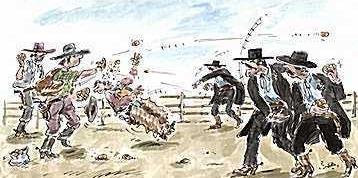
Over the last few weeks, there has been much mindless bandying about of ‘hung Parliament’ and ‘coalition government’ as if there was only ever one type of either. Thus, Ken Clarke says a well-hung Parliament would ‘play very badly in the markets’, while Alan Johnson says he has ‘no problems at all’ with forming a coalition. Both men could be right – or both entirely wrong, depending on the nature of the negotiations. This is the bit that people haven’t really thought about enough.
Given our current spectrum of Parties (and the extraordinary nature of the leading players involved in that rainbow of damaged humanity) I conclude that the negotiations for this particular hung Parliament would be something of a cock-fight taking place in a forty-round bare-knuckle boxing ring. Brief it won’t be – and this is why it will make the credit and currency markets nervous.
At the centre of this free-for-all (we can now be almost certain) will be Nick Clegg. His ideal result would be a damaged and desperate Labour Party: desperate enough to dump Gordon Brown, but not so damaged as to make it politically impossible for him to deal with it at all.
A more likely result, however, is that the Conservatives will have the most seats. Thus, constitutionally, they would have the best legal and moral case to be the subject of Cleggorian blackmail. Equally clear from the events of the last week is that the Tories will not want to give Clegg what he wants: and if David Cameron tries to do so, the Right wing of his Party will make life very unpleasant for everyone.
The man most likely to be dragged screaming back to the attic from which he was foolishly released is Gordon Brown, the Prime Minister. Those of us with a degree in Brown Studies are convinced that the day after the Election, Mr Brown will have convinced himself that The British People are really saying they want him to stay. Given he is likely to come third in terms of popular vote (if popular is a word one can use in relation to Gordon), the chances are that the Clegg/Cable starting point for any negotiations with Labour will be the immediate dumping of Brown…a man whom they both loathe.
There is a lot going for both sides in this outcome. Labour and LibDems could both claim that real change (forcing Cameron’s mantra down his own throat) had taken place: no Brown, no Darling….and a different Prime Minister. However, Nick wants that for himself – whereas Miliband and Mandelson don’t. Collapse of talks – and emergence of Anti-matter Brown as a raging bull within what’s left of Labour.
The real Left of the Labour Party will be almost entirely re-elected from safe seats infiltrated by Whelan’s Men – and at the head of their march for the non-existent Working Man we shall see the unprepossessing form of Ed ‘Fats’ Balls. Further, observers should not entirely discount the likelihood of Unite and other Trade Unions going the way of the Greek Left, and organising a series of serious strikes against cuts, sellouts, Tories, the IMF and various other Class Enemies. As the civil service would be on the receiving end of those cuts, we can also expect them to join in the anarchy.
The Miliband-Darling axis of pin-stripes will in turn combine uneasily with the Mandelson-Bradshaw knitting circle to raise the New Labour Blairite standard upon a last redoubt of spin. The problem is that nobody will want to negotiate with any of them. Thus it may well be that all of them will open separate discussions with….well actually, I’m not sure.
While the Government (and they will still be that) tears itself apart in the foreground, Slick Nick will try to engage David Cameron is a discussion about Vince becoming Chancellor, with Nick himself as (perhaps) Deputy PM and Home Secretary. The Tory leader may well be happy to dump Osborne if he can keep Ken Clarke in charge of Business; but ceding anything further would land him in trouble with enough of his Party to ensure that either in the short or long term, he’d wind up with his head on a spike.
The bottom line here is that post-election horse trading is going to be neither pretty nor effective. And above all, it won’t be quick. It will, in fact, be the stuff of which credit downgrades are made.
In a situation where Social Democrats are forming a coalition with the Right wing of a Communist Party, there aren’t that many things to be ironed out. A coalition requiring Conservatives to do business with UKIPs involves minimal difficulty. But when slightly unsocialist Socialists meet indeterminate Liberals in a situation where unconservative Conservatives have the most seats, the discussions, compromises, combinations, and schisms could keep the backstairs deals going for years.
Being a big, old and ugly beast, Ken Clarke grasps this. We should heed his warnings.
 The Slog