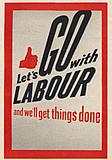
 Looking back now, it seems faintly daft that Harold Wilson thought he could borrow some stardust from the recently assassinated President Kennedy, but that is precisely what the Labour Opposition leader did from 1962 onwards. Dejected at how ad agency CPV’s slogan about ‘not letting Labour ruin’ life under the Tories had handed them a third term in 1959, Wilson studied the 1960 US election carefully. He decided – with his uncanny knack of isolating a simple message – that what JFK represented was a sort of science-fiction future: one in which stylish young men would blow away the dusty cobwebs of reaction, and banish the human struggle forever.
Wilson wasn’t exactly in the first flush of youth, and nor was he endowed with Hyannis Port style: this was a man who affected to have HP Sauce with everything. But we must remember that in 1964, he was up against Alec Douglas-Home, an ancient aristocrat whose skull-like features suggested he may already be dead, and merely a miracle of mechanical taxidermy. Methusaleh would’ve looked pubescent standing beside Alec.
Handling his own spin deftly, Wilson spent the whole campaign exciting the British with the idea of what he called ‘the white heat of technology’ scorching the plus-fours of old twits banging away at grouse on Scottish moors. Piling yet more opprobrium on this obvious dig at Home’s lifestyle, Harold Wilson persisted in referring to him as ‘the Thirteenth Earl of Home’. Not until near the end of the campaign did Alec brilliantly remark that the Opposition leader was most likely the thirteenth Harold Wilson.
Wilson was helped in his attempt to depict Douglas-Home as a stick-thin branch of petrified wood by (of all people) Private Eye, a magazine just starting out and keen to bash anyone who came from the same posh school background as them. They dubbed him ‘Dull Alec’ and the cruel soubriquet stuck. If only Wilson had known then what that beady Eye had in store for him in that future on which he was so keen.
I was sixteen at the time, and had never known a Labour Government. My solidly Tory parents drummed into me from an early age the potential evils that must befall any country beneath the jackboot of socialism. Although from a working class background himself, Dad equated all forms of failure and idleness with the desire to vote for a movement he would not refer to as anything other than The Layabout Party. For him, too many houses in a street displaying a Labour Party poster was a sure sign that the neighbourhood might head down rapidly towards street-fighting war-zone status at any time.
In fact, my guilty secret was not an attachment to socialism, but a growing hero-worship for the Liberal Party’s Jo Grimond. My parents never imagined I might be so eccentric as to support a Party with only seven seats, and full of mad ideas like metrication of the currency, joining the Common Market, and disgusting foreign voting systems. In short, until I returned from a first year at University two years later with theories based on flowers, wild sex and cannabis, I think I got away with it.
In 1964, Wilson’s Labour Party was very analogous to the Cameroons today: just as the Tories of 2010 are still trying to shake off their Nasty Handbag legacy, so forty-six years ago Labour was desperate to be classless rather than cloth cap, scientific rather than restrictive, and more Kennedy hope than Cripps austerity. Just as with Cameron today and his Right wing, Wilson’s Left wing suspected him of selling out the ideals of Nye Bevan et al. Just as Dave is castigated for making hard work of despatching the lame duck Brown, so too Wilson’s eventual victory – by just four seats – was seen by many in the media as a poor performance with only the Pleistocene Alec to beat. And perhaps most spooky of all, the Tory hegemony had lasted the same thirteen years as New Labour. (One of Wilson’s other soundbites was ‘thirteen years of Tory misrule’).
Despite all that, we woke up the next morning, and it did truly feel like a different world. I remember vividly my form master – nicknamed ‘Goofy’ for no particular reason beyond teenage cruelty – arriving to take the register, and smiling as he said, in his languid public-school accent, “And so verily I say -let us go with Labour’. We fell about laughing.
As it happened, Labour’s victory was followed by one of those periodic intervals when it feels like Britain might pull itself out of imperial decline and class constipation. The Beatles broke through, Britbands dominated the world, everyone affected a Scouse accent, and England won the World Cup. As Labour cemented its victory with a bigger majority in 1966, a summer of love followed, and it became fashionable to be a working-class actor, photographer and hairdresser.
This was the age of Terry Donovan, David Bailey, Michael ‘Alfie’ Caine, John Lennon, and many other stars from humble beginnings. Concorde – a supersonic aircraft no less – was put into trials, and by 1970 was flying: science fiction become fact, alongside human beings on the Moon.
But at the end of it all, there was a monumental cultural crash. San Francisco’s flower-power became hard drug iniquity, rock n roll ended on a sour note with Hell’s Angels pummelling a fan to death at a US Stones concert, and we Brits finally woke up to the fact that – unnoticed in all this hippy stuff – a devalued Pound had resulted from our declining craftsmanship and marketing. Whether intellectuals of the working class Left or upper-middle class professionals, the snobby British disdain for being ‘in trade’ was still alive and well. By 1976, we were broke: the IMF was on its way to demand we sort ourselves out. Plus ca change.
In 1964, Nick Clegg was still three years away from being a foetus. He was nine when the IMF rolled into Whitehall.
During the 1966 election, David Cameron was busily engaged in getting born. He was just eleven when Margaret Thatcher came to power.
David Miliband – the man most likely to at least temporarily replace Gordon Brown – was having his first birthday as England won the World Cup. When Wilson unexpectedly won the 1974 election, he was eight years old.
I’m all for youth if it’s got something fresh, original and compellingly relevant to say. But there are many times now – as the sixteen year-old turns sixty-two – when I wonder if I really should be asked to pay for yet another attempt to reinvent the wheel.
 The Slog