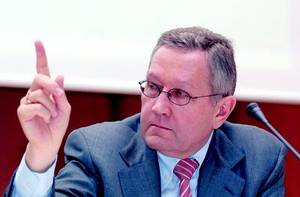
 Obersturmbannfuhrer Regling
Ten things you don’t want to know about the ESFS
1.The much-vaunted confidence boosting European Financial Stability Facility (EFSF) has been registered in Luxembourg, an onshore ‘offshore’ tax haven used by many European Hedge Funds.
2. It is to be headed by Klaus Regling, whose selection was a no-brainer given he is a German and has worked with Hedge Funds – thus making him acceptable to the markets and the Merkel.
3. He played a key role in designing the Stability & Growth Pact in the 1990s. This was the system he and others engineered to stop happening what is happening.
4. The EFSF was supposed to have started on July 1st, but will not be up and running now until the end of the month at the earliest.
5. Mr Regling said the fund was a temporary crisis mechanism, pretty much the same thing as Mr Peel said about Income Tax in 1830.
6. “I am confident that we will get the best [triple A] rating, maybe some time in August,” Mr Regling says.
7. Only a minority of the EFSF contributors have Triple-A status. Many commentators think Herr Regling is being optimistic.
8. An equal number of commentators also think (mostly in private) that the credit agencies will be put in an impossible position – and have to give the fund a Triple-A, whether it merits this rating or not.
9. Spelling out details of how the European Financial Stability Facility would operate, Klaus Regling said: “We will be ready to act whenever the politicians tell us to act.” Oh my God.
10. Herr Regling used to work for the IMF. He opposed reform to the IMF, and told critics at the time, “There has to be a trade-off between transparency and efficiency”. Last week the Economist noted that, ‘For such a large fund using public money, there remains a remarkable lack of transparency about how it plans to go about its business. Economists are still unsure whether it will be used to lend directly to struggling governments, buy their bonds, set up a European “bad bank” to take over bad loans or even to invest directly in banks that fall short of capital’.
Looks like this is all going to be very EU. Stay tuned.
 The Slog