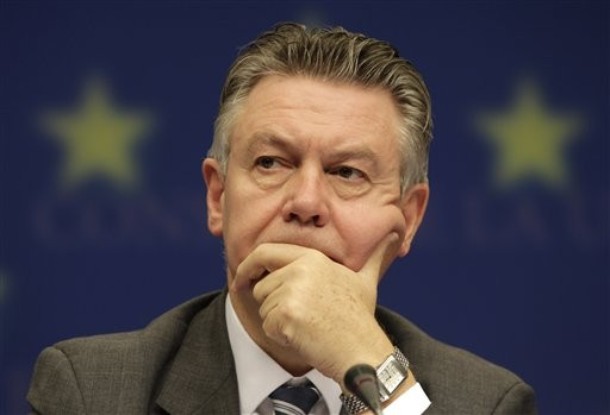
 EU Trade Commissioner Karel de Gucht
Norway’s ‘business as usual’ line doesn’t hold water.
Timing attracts scepticism among opinion leaders.
Suspicion falls on EU Trade Commissioner de Gucht.
When I discovered late on Wednesday evening last week that Norway was investing heavily in Greek bonds (to most thinking people these days, that’s the same as purchasing contraceptive sheaths with holes in them) I thought well, there you go – each to his own.
When I read the same news item for the seventh time the next morning, it seemed to me obvious that a coordinated spin campaign about Greek bonds had begun. As I read the laudatory, almost vomit-inducing confidence being placed in Greece by the Norwegian Finance Ministry in general – and its Sovereign wealth fund in particular – I began to wonder, “Is it me?”
Clearly, it wasn’t: Reuters blogger Felix Salmon was, as usual, on the case very quickly. Like me, he was suspicious of Norway’s near-philanthropic insistence on taking ‘an infinitely long perspective’ on ClubMed bonds:
‘…..having a long-term perspective doesn’t help at all. If a debtor defaults, it doesn’t matter how long your perspective is, you’re likely to lose money, and your bonds aren’t ever going to be worth what you paid for them. Unless you’re some kind of distressed/vulture investor, and Norway certainly isn’t that, default means you’re going to suffer a loss, whether you hold on to your paper or whether you sell it. End of story.’
I began to bash the phone a bit. My first port of call was an energy trader in Europe and Asia working at a very senior level in a German bank. This was what he said:
“As there is nothing remotely sensible about the position Norway is taking, you have to suspect a hidden agenda”.
What the Slog’s special investigation this morning suggests very strongly is that a back-scratching deal has been done between Brussels and Oslo in classically secretive, backstairs EU style: help rescue the PIIGS, and we’ll buy all your energy. First of all, however, we need to take a closer look at Norway.
Most people’s knowledge of Norwegians stops after fjords and fishing. But since discovering massive undersea reserves of oil and gas eighteen years ago, this small Scandinavian country has become the third biggest petroleum exporter in the world. For the past 15 years, the profits from oil have been paid into two sovereign wealth funds. Norway’s Government Pension Fund Global invests in stocks and bonds around the world. It’s now worth over 500 billion euros.
Norway is a huge exporter of energy because it had the foresight to use Hydro-Electric Power (HEP) to reduce its oil dependence to just 20% of all the power it generates. This isn’t the first time it’s bought ClubMed bonds – but the word is that Norway purchased a much larger amount than usual this time….and has rather abruptly changed its investment strategy.
In the view of lots of observers – including the Slog – Greece is a dead duck whose fate was sealed in July. But for the European bankocrats, a eurozone-leaving, defaulting Greece is unthinkable. They believe (as do I) that all confidence in Eurobonds will be lost as a result: the contagion would rapidly spread. Tricky Trichet himself said last weekend at the Villa Carlotta conference, “a Greek exit from the euro would be the worst possible outcome”. He meant for the EU – not for them.
How does this concern or involve Norway?
Norway is not in the EU, but large parts of its governing elite would like to be. Even though the Norwegians remain outside the madhouse looking in, as part of the EAA they accept a lot of Brussels directives – and cooperate hugely with the eurozone in general. The EU’s website trumpets:
‘Norway participates, albeit with no voting rights, in a number of EU agencies and programmes, covering enterprise, environment, education and research. Norway remains very supportive of the EU 2020 strategy, designed to create growth and jobs, which to a large extent Norway will also implement as part of the internal market…’
On 30th June last, Norway signed a firm investment agreement with the EU. Its foreign ministry website commented as follows:
‘The new EEA financial mechanisms give us a historic opportunity to strengthen our cooperation with the newest EU member states. Many of these countries are struggling with high unemployment and a difficult economic situation. It is in Norway’s interests to promote economic and social development in these countries,” said Foreign Minister Jonas Gahr Støre. “Norway will provide nearly 350 million euros per year to reduce social and economic disparities and promote cooperation in Europe in the period 2009–2014. The EEA Grants will be available to the 12 most recent EU members plus Portugal, Greece and Spain”.’ (My emphasis)
Translated into eurozone investment as a whole – including earlier Greek bond purchases – this strategy has contributed to a 17 billion euro loss in the second quarter of 2010 for Norway’s wealth fund. That’s a very big favour for a half in-half out eurozone member to do for its neghbours.
But last Thursday morning, even that policy made a quantum leap into what looks like madness. While remaining tight-lipped about the size of investment upweight in PIIG bonds, Norwegian Finance Minister Sigbjoern Johnsen bewildered most observers when he said that Norway’s “long-term investing strategy will shield us from losses….we are investing in the infinite long-term”.
Norway’s spin strategy in the light of awkward questions since then has been to insist that this represents no change in policy. Asked by the Slog last Friday, a senior Norges Bank source close to the matter said:
“This is not news, no it is not at all. On August 13, our wealth fund manager mentioned the Greek bond purchases. Sometimes the value of hearing about what a large player does might suggest a signal, encouraging others to make the same investment. This is not one of those times.” (My italics)
That’s a fascinating answer, given that first, it bears an almost word-for-word robotic resemblance to the Finance Ministry’s website spiel; second, I hadn’t asked about signals to others –merely about how big the investment had been.
And third, it must’ve been news to the Wealth Fund’s CEO Yngve Slyngstad, who only a month ago told the ai assets international website that there were no plans to purchase eurozone bonds – on the contrary, “We are reducing our bond exposure in the coming two years…..we are confident in our investments – confident but cautious”.
The Fund seems to have thrown caution to the winds – but I didn’t find out by how much, and I’m not alone in this. I’ve searched uphill and down dale on the internet for even a vague estimate of the amount involved.
“The point is, do you expect these guys to default?” said Harvinder Sian, senior fixed-income strategist at Royal Bank of Scotland Group Plc, in an interview. “Norway has taken the view that they will not. The Greek holdings are particularly interesting because the consensus in the market is that they will at some point restructure or default.”
This is Harvi’s polite way of asking what the fooey is going on.
“Given the broad consensus about default, the coyness about the amount involved is an issue for me,” said one Europe-based credit manager last night, “I don’t buy this business-as-usual line. Norway is taking a major position here, and shouting from the rooftops about it…but not saying how much. That suggests they’re embarrassed about it. It’s fishy, no question about it.”
If the amount about to be invested is enough to directionalise the ClubMed bond yields, it would embarrass the Norwegian Government domestically: there’s an animated debate in Norway about how the oil-money should be spent. “I’m not against us investing in stocks and bonds around the world, but I think more of the money should be spent in Norway,” says Siv Jensen, leader of the opposition Progress Party.
So if it’s not a vulture, what is the Norwegian motive and why the recent change of mind? The yield on 10-year Greek government bonds was at a stratospheric 11.6% last Friday – 9.4 points above what Germany pays for equivalent debt – and major sovereign lenders like Pimco have turned their backs firmly on Athens. Norway’s energy-wealth fund has purchased not just Greek debt – but also bonds issued by the governments of Spain, Italy and Portugal. Italy’s debt to gdp ratio is even higher than Greece’s.
“This is beyond contrarian” said a UK currency dealer, “it’s crazy. Well – either crazy or there’s a very rewarding upside for Norway we’re not being told about.”
Certainly, the timing of the fund investment could not be more propitious for the EU. And spookily, the following day the Greeks announced a concerted campaign to reassure the markets about Greek debt: Athens (literally) announced a rah-rah-rah roadshow:
“Although nobody in the government is talking about the possibility of restructuring our debt [are you for real?] there is increasing concern because spreads remain so high,” said a senior Greek government official, “We will try to change this by presenting to investors the progress that the Greek economy has made in the past months”.
That’s going to be a very short presentation, as the economy’s down 4% this year, and with every month the outlook forecast is revised downwards. But then, while a last ditch bunker-mentality scheme – ‘Nordic confidence in Greece followed by drum majorettes could yet get us out of this’ – might not be strong on the detail, it’s going to be high in desperation.
Can the Slog prove any of this? Nope. However, the plot doesn’t so much thicken as become crystal clear the more one digs into it.
I’m told that both Brussels and Oslo would like Norway to have a bigger share of the EU’s energy imports. Brussels is, after all, perfectly aware of how the Russians would blackmail Europe given half a chance. And currently, the Norwegians are supplying only 8% of the Union’s total energy needs.
In short, there is mutual benefit here: Norway removes the Russian tap-turning threat, and gets the euro out of a hole…and ensures that its big trading partner survives to provide an increasingly big market for its relatively expensive energy exports. But put as baldly as that – especially given how much Norway’s Government stands to lose both politically and financially – if I were a Viking, I’d want more than just a vague promise.
This was the view of a Brussels source I spoke to last Friday morning – an informant supplied by the Slog’s longstanding source there.
“One key player in this is the EU trade commissioner Karel de Gucht,” the source told us, “He is not a truthful man. He does secret deals. And he has been bullshitting a lot about Greek bonds”.
This checked out. De Gucht made a barnstorming trip to China in July, telling the Beijing government emphatically that “bonds from Spain and Greece are a good investment for China and will keep their value.”
He told Reuters on the same trip that China had “spent around 420 million euros buying Spanish and Greek bonds” – but when pressed, he would not confirm it. The Chinese weren’t impressed: instead they decided to buy Greece’s industry at knock-down prices, and negotiate some non-EU trade deals with Athens. Doubtless it seemed to them a much lower-risk strategy.
Evangelism is one thing, but this was pure Elmer Gantry stuff from the EU trade commissioner: to claim then or now that such bonds were anything less than extremely dodgy was inviting a raspberry in reply.
Just two weeks ago, de Gucht boasted to Business Week that the EU had “made it through the financial crisis that sparked concern Greece may default on its debt. Confidence in the euro has been restored. Our loan package to Greece impressed the market and made it calm down”.
The kindest critique one could give to those assertions is that they were a trifle previous. Bond spreads are higher than ever after the package, and in Q2 the Greek gdp slipped back a further 2%. On the very day the Norwegians announced their ClubMed bond-buying spree, Greece’s national statistics office said that private consumption dropped 4.2% year-on-year, against a rise of 1.5% in the previous quarter. The agency added that gross capital investment plunged by 18.6% in the second quarter, while exports fell 5%.
In other trade areas (notably with Pakistan) De Gucht has attracted criticism from fellow commissioners, with some colleagues accusing him of trying to “disguise trade deals behind other motives”.
The Brussels source again:
“He has confided to me and others that it is nearly always possible to have confidential agreements where a trade arrangement is purely bilateral. There is a strong feeling that he and others have negotiated a secret energy deal for Norway in return for the recent bond purchases.”
As we all know from recent experience, the EU, Trichet, eurobanks and Greek ministers have a track record of cons, secret arrangements and fraud. The banking stress-test was a farcical snow-job in which several banks colluded – by either fiddling or not declaring their sovereign wealth exposures. Trichet has issued many statements in the last six months that were later contradicted by other data or found to be completely untrue. His ECB policy, as an attempt to contain the eurozone crisis, is widely viewed as both dishonest, and pointless denial. The Greeks themselves obtained loans they hid from Brussels – and then hired Goldman Sachs to hide those further debts behind misleading accounting.
Now I’m told about the involvement of the EU’s Trade Commissioner – a post Peter Mandelson made a byword for graft – and that man’s own propensity for spouting bollocks when it suits the cause: which is, as always, the survival of the EU gravy train at all costs.
Read the comments of everyone involved in this – from the Norwegian foreign minister to the Greek finance minister – and it becomes blatantly obvious there’s a script in play: from top to bottom, the entire event looks like pure New Labour in its amoral heyday.
Of course, this isn’t proof. What the Slog has established here is inexplicable behaviour, financial and economic motive, hearsay, uncanny convenience, changed stories, Freudian denials, very useful timing – and a cast of characters with what old-fashioned coppers used to call ‘form’. We have no proof that this is another cooked pudding: but the proof of the pudding will be whether the markets eat it next week.
If they have any sense, they won’t.
 The Slog