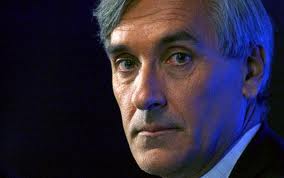
 John Redwood
New revelations about hidden bank subsidies will anger grass-roots Coalition supporters – and help to galvanise the Tory Right.
The Coalition of Conservative and Liberal Democrat MPs is approaching a series of hurdles, at any one of which it may tumble. The likelihood of slumpflation, the EU prisoner-votes fiasco, the rumbling phone-hacks scandal, and new revelations about disguised bank subsidies may evoke a nuclear option from dissenters way beyond Vince Cable.
Although the New Economics Foundation (NEF) is a sort of greeny-red mishmash of anti-big business ideas, there are some who’d say The Slog fits that description too. In fact, the NEF site is interesting in a sense that goes beyond Party lines; but either way, its report out today confirms what The Slog has insisted for nearly two years – that zero rates are there to provide effortless profits for wobbly banks – and a whole lot more besides.
The report suggests that high loan rates to customers, bank commissions aided by QE, and artifically reduced borrowing costs are the real drivers behind returning UK bank profitability, in that they’re worth around £32 billion a year. This makes a nonsense of Osborne’s £2.5 billion tax, it makes the banks’ anger at it absolute cant, and it renders greedy bonuses even more offensive than they were before.
But above all, revelations like these continue to make the Cameroon regime look like a group of well-bred chaps looking after their chums. And the same applies to Hackgate, a burgeoning scandal that is probably best summarised as The Coulson-Cameron-Murdoch-Hayman-BSkyB-Jeremy Hunt affair. It’s about to get much broader than that, but that’s not my point here: the fact is that once again, the privileged Cameron group appears to be in the pockets of a tiny oligarchy with a history of subverting British politics.
There is worse to come. This week sees the publication of both inflation and employment data. What I expect them to suggest very strongly (starting tomorrow) is that the phony recovery is now over, and the real trend – from recession to depression – has resumed its steady progress. The spectre of slumpflation lies ahead of us, and Mervyn King has run out of both weapons and options.
Regular Sloggers will know my view that the actions being undertaken (very patchily and sloppily) by the Government should’ve begun at the latest in 2008, and preferably during 2004. After 2009 closed with no remedial action, slumpflation was inevitable. Thus this Government isn’t to blame for it – but there are Unions and an Opposition out there claiming that it is. These deluded folk have been presented with an open goal by the banks; and Murdoch may yet give them another one.
Things are tense in the Cameronian inner circle. Oliver Letwin’s new nickname – the contraceptive – refers to him being snowed under trying to stop the birth of never-ending, daft and anti-British EU legislation. Ken Clarke, on the other hand, is busy sticking two fingers up to the anti-prisoner suffrage vote, and blithely observing that the Government will have to do Europe’s bidding in the end.
Clarke is also telling it like it is (at last) on the economic outlook, underlining at the weekend – much to the Prime Minister’s annoyance – how ‘tough’ things will get. And Cable was on Marr yesterday saying that the bank-levy tax is ‘a glass half-full’.
Finally, Osborne is approaching the Budget with a hawkish air, almost regardless of what the ONS economic statistics suggest. Cameron’s instinct is to be more cautious – a re-run of their covered-up disagreement during the General Election.
So we have indiscipline, resentments, squabbling, economics and perceived favouritism all acting against the Government.
Into this arena steps David Davis, the hero of Parliament’s defiant anti-EU vote. Davis flits relatively easily between the right and left wings of the Tory Party, and over the last fortnight has re-established himself as a potential rebel standard to which some may drift. And then there is John Redwood.
Redwood is a quality thinker. Although often the butt of ‘Vulcan’ jokes, he has displayed acute political instincts in recent years. He is especially thoughtful on the subject of economics, and last weekend wrote an interesting blog on his site. I felt this to be the key extract (My italics):
‘The left wishes to argue that much of the private sector is solely motivated by profit or self interest, which they think rules out that sector doing good for others. Where they accept that charities, mutuals and not for profit companies have a role, they usually judge their social purpose and their effectiveness by how much public money they attract….The test of the Big Society idea over the next four years is this. Will there be more mutuals, more charitable giving and activity? Will groups of public sector employees set up their own institutions to further the public good? Will there be new or more ways of joint working, and better ways of furthering the public good by private means?’
Not only is this the antithesis of Baroness Thatcher’s “no such thing as society” gaffe, it is very close to The Slog’s redefinition of a mixed economy as one of mixed motives, rather than ownership. There is also, I think, a sense of revulsion at the sight of a Conservative-dominated Coalition so completely at the beck and call of media barons, bankers and big EU government.
These are all things that exercise Davis – and the Tory Right in general. They would further find an enthusiastic audience from Malcolm Brady and his 1922 Committee.
A growing body of Conservative MPs and supporters are beginning to realise that there is a ready-made alternative to the ConDemned. One that has an alternative to both big government and big society. And one which – were the AV vote to go Clegg’s way – might make the formation of such a grouping outside the Tory Party far less risky.
 The Slog