Kroenke may well be wearing a white hat, but the black arts are still permeating all things Premiership
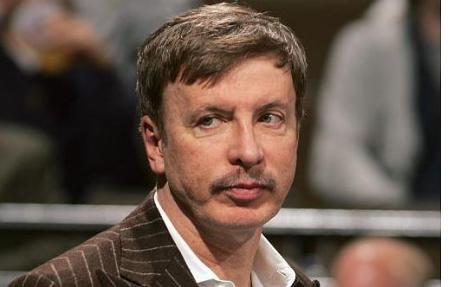 Stan Kroenke
Were the bid to take over Arsenal 100% (launched by US billionaire and 63% shareholder Stan Kroenke) to come good, we would have a tally of Premiership aristocrats entirely in foreign hands….and the league itself effectively bankrolled by an Australian phone-hacking organisation. But recent developments behind the scenes suggest that other even more sinister forces may be in play behind the scenes.
The de facto new owner at Arsenal looks at first sight to be a bloke who could do the Gunners a lot of good. His company, Kroenke Sports Enterprises, already has an ‘innovative strategic relationship’ with Arsenal through Major League Soccer team Colorado Rapids, and the group has a large portfolio of sports-related interests across the Atlantic. Unlike the cryogenic Glazers busy carpet-bagging at Old Trafford, Mr Kroenke would appear to have a genuine passion for what the north London club is all about. Added to that, if the bloke ever gets strapped for cash, he can always tap his wife for the odd billion – she is an heiress to the Walmart fortune.
However, taking stock of who owns what at the top of Murdoch’s soccer Premiership makes it clear what a foreign game it is that entertains us. Arsenal, Liverpool and Manchester United are owned by Americans – although United’s Red Knights group still entertains plans of a buy-back. Chelsea is owned by Russian-Vodka Palace sailor Roman Arkadyevick Abramovich. And Manchester City is owned by Arab money in the shape of 41-year-old Sheikh Mansour, now the richest man in the world.
The actions of these people have not, on the whole, suggested a Harvard Business School training. The overall effect at Manyoo has been lower-quality performances, much higher season ticket prices, rich supporters watching the movements of Glazer money like hawks, and a fan protest that Chairman David Gill continues to deny, but is evident at every home game. Abramovich is the epitome of impatient, childish mogulism. Liverpool FC geared itself so badly, it was nearly bankrupted by the previous owners. It too has underperformed badly in recent years. And while Manchester City have thrived under their Arab-imported Italian manager, there too revolving doors have been the order of the day.
The top of English soccer’s hierarchy has not so much manipulated the market as fed it amphetamines. Players are vastly overpaid – unaffordably overpaid in a top flight that has Sugar Daddies as its only business model – and transfer fees, like bankers’ bonuses, are removed from all reality. In the classic Friedmanite sense, a market whose prices are out of control has decisively attracted managers and players who are greedy, and owners who are egomaniacs. For the world’s new generation of billionaires, an English Premiership Club has become the must-have toy.
Economic deregulation and oil are the core causes of it all. The USA – where today there are 403 billionaires (eight times the 1990 total) – 1% owns 40% of the wealth. In the post-Communist, unregulated Wild West that is the Russian Federation, there are 62 billionaires. And Middle Eastern oil has made the tiny minority with money even more fabulously wealthy than before: the region has 57 billionaires, and a staggering 840 who are close to that. Neither the Russians nor the Arabs know how tiny a percentage of the total populace has all the money – probably because neither culture thinks the unwashed to be very important.
The theory has thus always been that there is no shortage of vulgar megalomaniac mugs rich folks to underpin the Premiership’s finances, but such thinking is deranged. The greed at the top of the English game has starved the nurturing of our own talent so badly, England has been an also-ran World Cup nation for two decades. And graft is always likely where there are Aussie phone nuisances, above-the-law wealth, and Sepp Blatter in the mix. The 2022 World Cup will be played in a country where daily temperatures average 47 degrees centigrade. The one before that will be played in…..Russia. Money is clearly changing hands, as Lionel Bart’s Fagin once sang, in large amounts.
Of all the New Bourbons, the Russian wealthy have shown the greatest global desire to indulge their imperial fantasies in sports club ownership. Mysterious and shady characters like Mikhail Prokhorov (who owns U.S basketball team New Jersey Nets, but shows little knowledge of the game) have huge ambitions in the sector. But they come from what one could call unreliable pasts – not for nothing do away fans at Chelsea shout “You’ll be f**ked when the Russian goes to jail”.
Joking apart, the security surrounding these people has to be seen to be believed. Some of it is physical (you make a lot of enemies clawing your way out of the bear-pit in Russia) but as much is now technological: the Russians may not be the most civilised nation on the planet, but they have embraced cyber-war as a concept more than most.
How odd it is then that atop this seething morass of wriggling egomania and hack-blagging sits Rupert Murdoch, a man who knows a fair bit about cyber conflict, allegedly. But perhaps what most observers don’t grasp is just how close the man with a globalist nationality is to this Russian clique. As one previous Slog-blog mentioned in passing, I’ve been keeping a jaundiced eye on the use and misuse of technology by Russians in the London area, specifically in the region of Chelsea Harbour.
It seems that recently those occupying this London outpost of Muscovite sophistication were laughing long and hard about what they’d overheard during a candlelit dinner between Murdoch the techno-digger and Abramovich the Russian oligarch on the latter’s yacht. All of which suggests that Roman needs to invest in an overhaul of his anti-cyber equipment on board.
At the same time, there are intriguing possibilities regarding the Uzbeki Arsenal investor billionaire Alisher Usmanov – and what this secretive man will do as and when the new Yank on the block makes him an offer he can’t refuse. The Slog hears that he is already looking to be a bigger fish in a slightly smaller pool.
There are going to be fireworks in English soccer over the next year. Murdoch journalists have been hacking the FA – and some allege this was done at least partly to find out in advance what the bargaining ball-park might be. Meanwhile, other Russians keen to get into the game are hacking the hackers. The next global banking collapse will challenge the Premiership’s business model. And Murdoch’s continuing attempts to contain charges of unwarranted political interference in the UK could collapse his patronage – especially if the American press and political set decide to go for his jugular. Very few Brits realise that detestation of the techno-Digger is even more virulent in the States than here. In the area of media manipulation, thinking Americans tend to be far more alert than their Limey counterparts.
What does all this mean for the English game? Just this: when the US debt-solids hit the fan, Red Knights alone will not be enough to save the FA. When the value of oil is no longer at its current crazy peak, Premiership soccer will require a form of patronage beyond the Sugar Daddy. And when the Russians are either rubbed out or forced to retract, dodgy oligarchs aren’t going to be around to subsidise insanity any more.
“Flat caps, terraces and jackets for goalpost, oh yes”. No – that is never going to come back. But we need to keep an eye on English soccer (even if some of our number mistakenly see it as 22 blokes kicking a leather sphere around) because it’s part of our cultural problem. A culture in which money talks, but ultimately has nothing to say beyond “It is what it is”. Bollocks: the Beautiful Game is uniquely attractive because it combines manly team endeavour with individual genius in a way no other sport can. It is a bastion of physical artistry and honed craft skill in which silly money has nothing to offer. Only when the officials in control of the game realise this will the country that invented the bloody thing return to prominence.
 The Slog