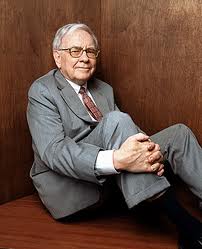
 Buffet….in a corner?
Warren Buffet’s power has a habit of making his predictions self-fulfilling prophecies. But is he as saintly as he’d like us to think? And does he really believe in US recovery? The Slog digs around to find out.
Warren Buffett’s image in the financial world is better than most. No other player has such a long track record, or managed to build such a reputation for being right.
Buffet is the boss of, and biggest shareholder in, Berkshire Hathaway. He frequently rails against market stupidity, Wall Street crooks and banker hubris, and as such he has shaped an image of himself as the successful big guy who’s also on the side of the small guy. This makes him appear unique.
And alongside this, of course, he is known throughout the world as The Man Who’s Never Wrong. His currently famous big bet is on US recovery. In taking this stance, he has attracted a lot of investment into America’s stock market sector. And having bought near the bottom two years ago, doing such a thing is entirely in his interests.
Eighteen months ago I said this was a call Buffet had wrong. My view today is that he knew it was ‘wrong’….but that he could make money by directionalising the wrong folks.
The world’s opinion-leader financial media have glossed over Buffet’s less than perfect features for years, preferring to focus on his perspicacity. But there is change in the air now.
Bloomberg’s columnist Jonathan Weil wrote recently that the press has given Warren Buffett very gentle treatment in past scandals.
Our Warren kept quiet during the 2008 financial crisis as Moody’s blithely handed out “AAA” ratings on junk bonds. And guess what? Berkshire owned a fifth of the stock at the time.
He headed Coca-Cola’s audit committee for years. The SEC issued a cease and desist order against the company for misleading earnings statements.
Mr Buffet was well aware of the contracts between Berkshire’s GenRe unit and American International Group Inc. for which GenRe paid a $92 million fine and four executives were sentenced to prison.
The SEC whacked Warren again after Berkshire and its audit firm, Deloitte, allegedly violated the SEC’s auditor independence rules.
And Buffett himself appears to have violated Berkshire’s disclosure policies. The David Sokol scandal (about violation of Berkshire’s insider trading policies) doesn’t contain much in the way of ‘duty of candour’. This applied to Sokol, so presumably it should also apply to Warren Buffett.
But in a press release during late March 2011, Buffett wrote that Sokol’s purchases of shares of Lubrizol, a company targeted as a Berkshire Hathaway acquisition candidate, were not a factor in his decision to resign. Bloomberg’s Weil retorted that the line “wasn’t remotely credible.” Buffett himself admitted at his Annual Meeting the trades were a firing offense, and turned over evidence to the SEC’s enforcement division that contained what he called “some very damning evidence”.
So it’s odd that it doesn’t seem to have damned Warren to anything except what most perceive to have been just bad luck. Or perhaps – dare I suggest such a thing – dereliction.
As the FT’s Jonathan Davis noted yesterday,
‘More worrying for any long-standing Buffett admirer is the evidence that his latest big idea was sourced from a list of potential targets supplied, in the first instance, by a corporate financier at Citigroup, from whom Mr Sokol originally got his idea. By his own admission, according to the Berkshire Hathaway audit committee report, Mr Buffett admitted not knowing enough about the lubricants and additives business to form his normal, more or less immediate, judgment on the merits of a deal….’
And the other interpretation – perish the thought – is that the wily old Buffet distanced himself in this manner in order to better avoid the flying solids.
 The Slog