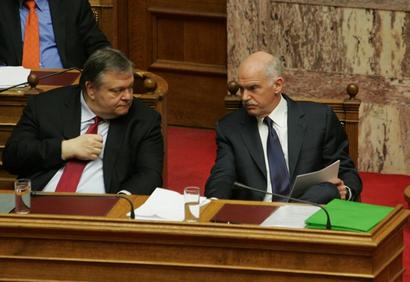
 Venizelos & Papandreou…..sworn enemies
New finance minister Venizelos ran Olympic budget $1.7b into the red
Juncker cautions that Italy is vulnerable…and credit sources warn of even worse corruption there
—————————————————————
German suppliers are implicated in new revelations about Greek government corruption. The new Finance Minister Evangelos Venizelos is also shown to have a chequered past – and there are allegations that US/IMF pressure forced him on the Prime Minister.
After two days of dissent inside his Socialist party that threatened to bring down the Greek government, Prime Minister George Papandreou has named his main rival for the Party leadership as finance minister. Greek political analyst Ilias Nikolakopoulos was blunt, stating in an interview last night that,”Papandreou has forged an alliance with his chief enemy. This will essentially serve to calm party rivalries.”
But there are allegations in credit management circles this morning that Venizelos may have been an IMF diktat, as his recent statements on debt repayment have been extremely hawkish. This would make sense, as the International Monetary Fund require Greece to pass the austerity measures before releasing the next 12 billion euro ‘bridging’ loan – before what may now turn out to be an eye-popping 150 billion euro package is delivered to the Athens Treasury.
Only last year, a package of similar size was agreed by the EU, but it has gone – allegedly on debt servicing, but also (say some in the credit sector) because expenditure savings were diluted….and some monies have gone missing.
The Slog posted recently about the inexplicable decision to sell Greece’s default insurance (State money) to a Swiss group where – it seems – the money is now in the private hands of senior Athenians.
Meanwhile, it emerged yesterday that French and German banks have also taken out cdo insurance against a Greek default….with Wall Street firms.
“If Greece goes,” said a UK banking source last night, “Wall Street will take a $127 billion hit”.
Evangelos Venizelos is seen by many in Greece as having deliberately taken a harsh stand on debt repayment as his fast route to the top job – Papandreou’s job. But until yesterday, he was the Defence Minister struggling to contain the ever-louder rumblings about graft in a submarines contract given to a German supplier. The issue was tabled again in Parliament yesterday by Popular Orthodox Rally (Laos) party leader George Karatzaferis.
“The Government will continue to shed light on this matter,” Papandreou said, after Karatzaferis pointed out that the document sent by the public prosecutor “seeks the indictment of half your government and the Government Council for Foreign Affairs and Defence (KYSEA) of that time, of which you were also a member”.
The Chairman of that Council was Evangelos Venizelos. As if to draw attention away from the allegations, last Wednesday Venizelos himself made some sensational accusations about German companies fulfilling the submarines deal. He charged German enterprises with encouraging corruption in his country over a long period, specifying bribery in a deal to buy submarines from the Ferrostaal firm.
“Our European partners should help us monitor the application of transparency rules, which are not violated uniquely or mainly in Greece, but above all in the countries of origin of the entreprises…..at a certain period, all the big German companies dealing with the Greek state were creating a problem,” Evangelos Venizelos told a Greek radio station. He also named the vast Siemens group as one committing similar offences. In total, he suggested, $140 million in bribes had been paid. (Of course, if you don’t ask for a bribe, it’s highly unlikely one will be offered).
The alleged offences took place in 2002 – long before Venizelos was at Defence. But Karatzaferis may well be referring to an equally grubby element in the history of the submarine purchases. Last September, the Defence Ministry oversaw
a deal to transfer a majority stake at Hellenic Shipyards, the country’s main shipbuilding facility, from ThyssenKrupp Marine Systems to Abu Dhabi Mar ‘in order to protect thousands of jobs’.
But like the transfer of public CDO insurance to a private Swiss investment firm, this too has been the subject of questions in Parliament. Opposition LAOS Party leader Karatzaferis also voiced serious misgivings about a late-night visit by the current Supreme Court Prosecutor to the home of a government minister, while sensationally claiming that a former minister in the Defence Ministry suddenly had 178 million euros in a bank account. Allegedly, the bank account is in….Abu Dhabi.
Although being clearly positioned by the Opposition as a pocket-lining crook, however, there is also a sense that Evangelos Venizelos is the last person who should be finance minister – on the grounds of incompetence alone. For he was the man in charge of running the 2004 Greek Olympics preparations. They went massively over budget, and most of the excess was absorbed by the State. The Games budget was originally $9.4 billion, but had to be increased to more than $11.1 billion over the last few months. A cloud remains over Venizelos’ head about the affair, although he has never been charged with any offences relating to the suddenly increased costs.
“Many of the venues are still vacant,”
says Andreas Efthimiou, the deputy mayor of the Athens suburb where the Faliro Bay Olympic Complex was located. “There were promises of money-spinning ventures. But after the Olympics, nothing was done. We lost the chance to change the face of the city.” Many Athenians remain explicit about side-deals and pay-offs, bribes – and new villas suddenly afforded on the islands nearby.
But this is the nature of things in ClubMed….and now Italy is back on the radar as an even worse example of falsified returns made to Brussels, alongside huge State bribery and embezzlement.
A Madrid-based credit source told The Slog this morning, “Italy is the one they’re [Brussels, France and Germany] truly worried about. If it hits at the same time as Spain, the eurozone is dead. But the Spanish and Portuguese situations are relatively transparent. In Italy, everyone realises that the can is going to be full of much worse things than just worms”.
The Italian Government’s deficit is still very modest – about 4%. But the country has been overspending since before most financial commentators were born: so although its national debt is long term and low interest, it is 127% of GDP – more than any other eurozone State….and vulnerable to a deadly mix of rising interest rates plus falling credit-sector confidence in the euro.
As it happens, Italian banks rarely lend money abroad – so the ‘contagion’ effect should pass them by: like the Japanese, most government debt is owned by Italian citizens and companies. But there is another element with the Italian authorities that remains an infamous secret among credit suppliers.
“Cutting to the chase here,” said one to me last week, “You can’t trust anything they say, any figures they give you, or any percentages they offer as reassurance that everything’s OK. Italian borrowers are like Russian borrowers: they’re vague on the truth/lie thing. And of course, in both cases the Mafia is an unknown quantity”.
A senior Milanese business source
told the FT some months back, “There is no example in history of a debt the size of Italy’s ever being paid back.”
Luxembourg’s Prime Minister Jean-Claude Juncker heads the group of eurozone finance ministers. This morning, he warned that the euro crisis could easily affect both Italy and Belgium “due to the sheer scale of their debts” – a disastrous place to be when credit confidence is waning. Juncker also said he was “confident Greece can eventually turn the corner, but it will take longer to beat its problems than previously believed.”
This is absurdly optimistic in my view. But in answer to the question, “Why don’t you just let Greece leave the eurozone?”, Juncker lost it, describing the suggestion as “an absurd idea with unimaginable consequences….
there would be a contagion not only across the eurozone but also in Romania, Bulgaria, Macedonia. It would cause widespread fire. Even the most outlandish don’t raise this hypothesis”.
Protesting a tad too much there, Jean-Claude. Without ulterior considerations involving bank collapses and the end of his EU dream, it would actually be the obvious thing for Greece to do. Sooner or later, in fact, somebody probably not Greek is going to force this issue. When they do, watch out.
 Venizelos & Papandreou…..sworn enemies
 The Slog