
Not being a keen student of the news, our mirabelle tree carried on ripening this week, blissfully unaware of the disastrous state of EU finances, and the steady demise of Newscorp. The week before, the weight of its fruit became too much for a couple of ageing boughs, and they collapsed. Everyone round here has the same problem: the dry spring has brought a bumper crop of fruit.
We already have a freezer full of cherries and six pots of cherry jam, so where the mirabelles (then the prunes, then the greengages, then the apples, then the damsons, then the pears) are going to go is anyone’s guess – apart from into our guests……and more pots of jam, apple sauces to go with pork we never eat any more, and magret de canard aux pruneaux. The last is a lovely dish and very typical of this area, but you can have too much of anything – especially prunes. While it’s very nice to wander around our land picking a wild damson here, a blackberry there, and prunes everywhere, it’s best not to wander too far from the house – otherwise a rapid sprint might be in order.
The biggest problem, however, is the quinces. Take a tip from me, and don’t grow quince trees. “Oooooh,” says every last visitor, “you can make quince jelly”. This is the complete list of what you can do in the way of edible uses for quince. That’s not entirely fair: you can add it to mince pie fillings, and make soup from quince, walnut and pumpkin; in fact, quince, walnut and pumpkin soup is the business. But while pumpkins are nice, they’re huge. Walnuts are even nicer, but our tree drops about a thousand of the beggars. I’m sure this is how qwp soup was invented: somebody said “Chuck em all in a soup” and it worked. But you wouldn’t want something made from quince every day. For six months.
Over the years, we’ve become increasingly ingenious about quince disposal. Ramming them into mole and rodent holes is good: nobody and nothing likes raw quince, and so as a deterrent, quince is up there with garlic against vampires. We sometimes throw quinces at the deer who wander over our land destroying tree bark as they go. Quinces also make excellent cricket balls, and you can play a sort of makeshift petanque with them. I once fiddled with some wood and elastic trying to make a catapult launcher that might amuse and otherwise silence our neighbour M. Mourgue’s endlessly noisy animals. I never got it to work, but for laying siege to castles (and poisoning the inmates) they’d be hard to beat.
Once having ripened to a yellow colour, they do actually look and smell very nice. So for a while we took to putting them in bowls in guests’ rooms. We heard back some months later that one group had told an old friend of Jan’s, “the hospitality and grounds are wonderful, but the pears are very hard”.
The ultimate problem with quince trees is that they produce hundreds and hundreds of these huge, hard lumps of uselessness; and because neither insect nor rodent – not even squirrels – will go near them, every single fruit survives. What’s more, you can’t just leave them on the ground: I’ve bent a tractor-mower blade hitting them before now. The only real solution would be to invest in a whopping great press and still for the cellar, and render the quinces unto something that, if nothing else, could alter the consciousness when winter life palled. This is quite big in Spain, and may explain the decline of the Spanish empire to some extent. They make a brandy out of it, but the snag is that you need to start a sugar-cane estate to sweeten the stuff.
Another more ambitious idea, however, would be to make quince liqueur, and export it to Japan. After a lifetime of consuming Japanese goods, it has long been my aspiration to flog something back to them; and there’s no doubt that they like quince liqueur. They call it karinshu, and it’s a simple white alcohol 35% base flavoured with quinces, for which the Nipponese term is karin (the symbols beneath the header shot) – hence, karinshu.
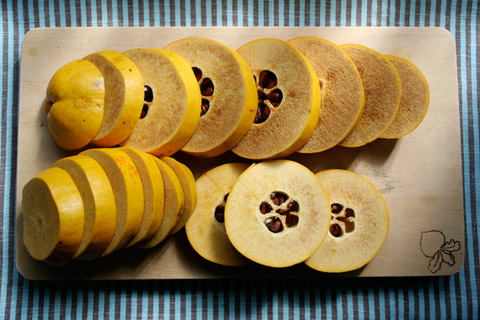
Rather like the sloe gin idea, you simply slice up the quinces and steep them in alcohol and sugar, seal it all up and then wait for quite a long time. (I’ve written ‘simply’ slice there just to encourage you: slicing quinces isn’t remotely simple. You’ll need a chainsaw.)
Anyway, if you fancy having a go, the recipe’s here.
 The Slog