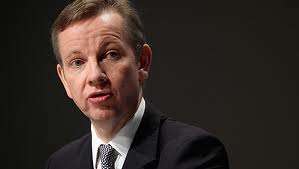
 Education Minister Michael Gove
As exams get easier, those behind the State system stand accused of utter failure
While attention should rightly be focused on the growing number of A* results awarded at A-Level – it remains obvious to anyone who knows about marking methods that standards remain woefully low.
The A-level Exam quango Ofqual (yes, it evaded the bonfire) states that a vital responsibility is ‘to ensure that standards are consistent across time and across awarding organisations in the interest of candidates.’ To me, this aim has always been cockeyed (I’d rather have ‘better’ than ‘across time’) but while ‘awarding organisation’ consistency is important, the one thing Ofqual doesn’t look at – as far as I can tell – is the range of results by school type and area.
For anyone who’s been around in England and reasonably alive over the last thirty years, it’s been obvious that private school kids and south eastern based kids get a better education. The Guardian to Mandelson axis of bollocks see this as prima facie evidence of ‘privilege’ and ‘unfairness’, but it is nothing of the kind: it is merely a reflection of the facts that (a) private school teachers both practise and expect much higher standards of teaching than the fraternal-greeting-colleagues spouting correct nonsense in State schools; and (b) thanks to the attentions of Thatcher (and the inaction of New Labour after 1997) the South has stronger economies and communities which tend to better educational results.
One saw signs of this after the last Olympic Games, when it was pointed out that ‘our great medal success’ as trumpeted by Gordoom was in fact a triumph for the private sector – with roughly 7% of all pupils, but over 50% of all medals.
Regardless of Party, all these realities are a national disgrace, and a damning condemnation of both Government and State teachers. The Blairite ‘education, education, education’ soundbite turned out to have as much substance as being tough on the causes and reality of crime. And looking at some of the numbers behind today’s results, this becomes ever more obvious. Two in particular stood out to me.
Pupils at private schools, now with only a 6.5% share of education in Britain, achieved 30% of A* grades at A-level this year. But the north-eastern State schools produced only 3% of A*s from 4% of entries.
A third of under 25s are jobless in Middlesborough, 3 in ten suffer the same fate in Cleveland, and 1 in 4 have no work in Sunderland. As a trained researcher, the link in the context of a mountain of other evidence saying the same thing is, I’m sure, causal. In fact, where there is little aspirational child-encouragement apparent in the home, that makes such areas the top priority for high-quality civic teaching to produce young people who both believe in themselves and care about the needs of others.
Now the Labour solution, of course, would be to chuck money at the problem. But all governments did that after 1985 in Tottenham – and we can see exactly how much difference that made to the price of fish. This is one field of endeavour where the Left really does need to turn the telescope round the right way, and accept that improving education in Britain isn’t about forcing their State failures onto horrified Oxbridge entrance examiners. Rather – and this applies to Camerlot too – Government needs to learn much more about what the private educational sector is doing right.
My own view (having privately educated two kids, but myself benefitted from a once great State system) is that 90% of the battle comes down to maximising the number of teachers who want to encourage excellence and independent thought in a depoliticised State system. Under that system from 1946 until roughly 1970, Britain saw the most appropriate and longlasting social mobility in its history. Under New Labour, education of the rich and truly privileged improved – probably because government had nothing to do with it. But the gap between rich and poor – between north and south, low and high social class, State school and Private – became wider still.
We don’t need any more teachers whose subject grasp is shoddy, judgement about behaviour fluffily correct, and knowledge of the Class War encyclopaedic in nature. We need teachers with a calling, and community leaders keen to cooperate with such people. But above all, we need to get rid of the 1970s/80s crop of ‘anti-Fatcher, it’s de cuts, an’ solidarity with the miners’ pillocks as quickly as possible.
 The Slog