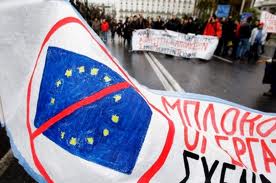
 The EU is splintering along the faultlines of national self-interest
As Geithner shocks Wroclaw delegates with “no money for EFSF” statement, Spain’s debt burden rises further, the Dutch cast doubt on further bailout contributions, and the Finns refuse any collateral compromise.
I do not doubt that, when the history of the eurocock-up comes to be written, the Polish town Wroclaw will loom large under the heading ‘Immediate-term causes of the Disaster’. There is a fifty year-old track of Peter Cook doing an impression of Harold Macmillan briefing the media after a visit to Germany in 1961. The classic line is, “The German Chancellor and I had a spirited debate in our respective languages”. It looks like Tim Geithner of the US Treasury and the EU finance ministers just did the same thing.
What a mess. First of all, we have the two Ruritanians in attendance, Jean-Claude Juncker of Radio Luxembourg and Diddlysquat Reindeers of Belgium, both of whom didn’t take kindly to Geithner’s do-as-I-say-not-as-I-do address. Bless, the poor dears seem to have had their beautiful plumage ruffled. “We are not discussing the expansion or increase of the EFSF with a non-member of the euro area,” said Juncker. And Diddly added, “I’d like to hear how the US will reduce its deficits … and its debts.” Unfortunately, neither man was taken out and shot.
Second, we have Tim Geithner giving a lecture about ‘leveraging the EFSF’, with most of the audience being unaware until halfway through that Tim wasn’t actually planning on making a contribution himself personally from an American direction going forward, as it were. How on God’s Earth did that happen? I don’t think it’s an exaggeration to say that the overwhelming eurocrat and media expectation was that the Federal Treasury Secretary was going to bring a bag of dosh with him. Certainly, Wolfgang Schauble thought so: afterwards, bewildered Austrian delegate Maria Fekter said that Herr Schauble had called openly for the US to participate in the bail-out fund, but Tim Geithner had “ruled it out emphatically”.
I wonder what he actually said: “Are you f**kin’ nuts or what?” is a strong possibility, but for the American Treasury this has turned into a PR disaster. What a Page One misunderstanding. Both the Slog’s Brussels mole and a Frankfurt source were clearly of the view that the US central bank would be joining in the systemic irrigation begun by the ECB four days ago. Anyway, European Union Financial-Services Commissioner Michel Barnier said it was “very positive” to have had the U.S. Treasury Secretary there; he just didn’t explain how or why. Nor, by the way, did he explain what his job is. It seems to me that Barnier, Olli Rehn, Van Rompuy, Manuelo Barroso and 27 finance ministers is an awful lot of people to be sorting out one debt. Overcrowded dance floors make for sore toes.
For Schauble himself, it goes once again to prove that 24 hours is a long time in politics. He and Frau Merkel will now have to rethink how their ‘Greek default within the eurozone’ plans might be salvaged….a task that will surely be complicated by growing dissent back in Germany. A survey out today by YouGov, on behalf of the news agency dpa, shows 82% of Germans dissatisfied with the crisis management of Chancellor Merkel’s coalition. Two thirds of respondents said they were against providing financial assistance for Greece – or indeed any other financially ailing eurozone member State. And adding to Merkel’s woes, the SPD flatly refused to consider joining any national Coalition, saying they would demand an election if the CDU/FDP partnership collapses in future bailout votes.
Earlier in the week, The Slog reported on leaks alleging that the Spanish and Italian Governments were sounding out Brussels about being relieved from the next Greek bailout tranche. Although this was never confirmed, a leaked Dutch Government document today suggested that they too are asking for their EFSF contribution to be capped at 100 billion euros. This is almost certainly related to the fact that Holland’s budget deficit just doubled to 3%. And Finland’s view at Wroclaw was very blunt: “Sure, let’s negotiate some more. But it’s not going anywhere – without guarantees, we won’t send any more money to Greece”.
———————————-
Some time ago, the bailout word was verboten. Then the default word. Then the eurozone exit probability. Then the eurozone slimmed-down strategy. Then the euromeltdown likelihood. Today in Brussels, what one mustn’t mention is the EU break-up possibility.
The European Union now has so many unmentionables, press conferences for the clowns running it are becoming increasingly tortuous. Everything must be denied: multiple insolvency, bank undercapitalisation, Greek backsliding, tranche withholding, Italian dissembling….the list is almost without end.
But over the last week, what we’ve seen – in every sense – is the not heart-failure of the eurozone, but that of the European Union. This is not merely idle wish-fulfilment among a few headcases in the Nigel Farrago circle: there are growing signs that the will to move Europe onto the next stage of being first a fiscal and then a political union is ebbing away.
I noticed the first signs of this in France last year: reckless spending on unnecessary infrastructural renewal wasn’t the action of a nation firmly devoted to a well-run, longterm European State: it was the French (as ever) taking the piss. One had always felt that, the minute the current of money started diversifying away from the French, they’d lose interest in the European ‘ideal’. Friends in Portugal reported to me two months ago a general attitude of “What’s the point?” It’s been clear for three weeks now that the Athens government is playing games, and has no intention of formenting revolution by enacting the Troika’s entirely daft austerity ideas: they have no feelings any more about a better Europe, only a nose for the best deal they can get. The Finns have dumped any pretence of the greater good in favour of not chucking good money after bad. And while things are very bad in Spain, talk to senior civil servants and they will tell you that their country has done more than enough. Italian Government officials are now openly asking what good can come from saving Greece. In private, they ask what good the euro has really brought to them.
In many ways, the Czechs, Hungarians and Romanians never got the USE bug anyway. The last especially has simply worked the migration system to its own advantage, and Hungarian ministers have, on several occasions, told all variety of Brussels officials to go take a running jump. None of them are interested in saving the Greeks. And as for wannabe EU member Turkey….well, I’ve never been in any doubt as to why the Islamist Recep Erdogan wants access to EU passports. His higher cause is, after all, a rather different one to that desired in Brussels.
The main player in all this, Germany, has been the most nationally destructive of the lot. Once it became clear to Angela Merkel that she might lose power by moving The European Project forward, she abruptly changed tack. Her Coalition colleagues want Greece to leave the eurozone and then demurely default, and this represents only a slightly more polite way of expressing what 66% of German voters told YouGov this week: no more money for Greece, period. The French have gone along with Frau Merkel’s various twists and turns only as long as it looked like this might save French banks. For Sarko, saving the EU isn’t much of a motivation. What Nicolas is into right now is saving his own electoral neck.
The British, of course, were never keen in the first place…but were ignored by successive governments. Today, 53% don’t just have EU doubts – they want to secede tomorrow. Between them, Cameron, Hague and Osborne have shown rather more interest in coke, men and black escorts than they have in Brussels. Sadly, they have also shown zero interest in leaving the Union in search of a more stable and lucrative trading partner. Camerlot as a whole takes the view that the EU is “an imponderable”. Now it’s an implosion, we’re none the wiser as to what their policy is, or indeed might be. Joking apart, this is a disgrace of historic proportions.
What all these variously motivated EU members have in common is remarkably easy to define: they have no affection for the EU they created, and they have no stomach at all for the near-impossible job of uniting Europe. The EU has been – for the French, the Sprouts, the otherwise unemployable, the Germans, and an enormous number of political rejects – a port of convenience. Now it’s turning to sh*t, none of them is prepared to chuck serious money into the fund.
But surely, many people ask, they are chucking very serious money at the EU’s survival?
Wrong: they’re throwing our money at a eurozone banking problem. Now the stakes have become very high indeed – parochial political survival – nobody wants to know about ‘the European Project’…except as a useful lie during press conferences. And if all this sounds a bit sniffy-Brit and superior, let me say here and now that David Cameron’s preference for a united Tory Party over a United Europe is every bit as provincially shallow as Sarkozy’s obsession with French banking, and Merkel’s desire to one day be remembered as the Fuhrerine who led the Germans back to leadership of the continent: even in this last case, she’d rather remain leader of a powerful Germany than fail to become some kind of latter-day Holy Roman Empress.
These alone are enough reasons why the EU – whatever stuttering phases it may go through from here on – is doomed. Other factors are more obvious – social unrest, inability to compete globally, bloated functionary spending and endemic graft – but by comparison these are merely the internal contradictions involved in building something made largely of hubris. What we can see, at last, is that the will simply isn’t there to endure the pain involved.
I’m not opening ‘o7 Krug just yet. But I shall sleep soundly tonight.
 The Slog