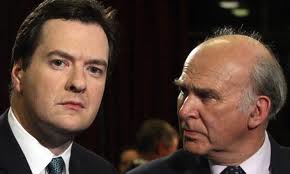
 “Like a war” Vince tells LibDems…but are we armed?
Osborne strategy in tatters as observers ask: “What happens when borrowing gets tougher?”
David Cameron is careering around the world to tell everyone how GREAT Britain is, and Danny Alexander is going to hire 2,250 tax inspectors to stop evasion. But it all sounded rather thin this afternoon when a £12 billion hole in the deficit reduction budget appeared as if by magic.
In a highlighted piece today(£), the FT shows how, by running the Office of Budget Responsibility(OBR)’s model, even if there is no slippage in borrowing from previous forecasts, the level of spare capacity in the economy is lower than expected, so the OBR will not be able to forecast as much catch-up growth as it did in March.
As The Slog has said with tedious consistency, we were always asking a 13% sector of the economy – manufacturing – to shoulder far, far too much of the growth required to boost tax income and thus speed up the deficit reduction. But now the FT adds for good measure:
‘More of the deficit appears permanent and will not be eliminated by a bounce back in the economy’.
I would certainly take issue with the word ‘permanent’, because it’s meaningless: I suspect what the Pink ‘un means is ‘structural’. But even so, the implication is clear: the only way to catch up with deficit reduction now is new source(s) of Treasury income. Any involvement at all in EU meltdown remedial action would only make things much worse. I suspect a VAT increase is being considered as I write.
While The Slog is often viewed by casual visitors as a non-stop slurry of miserable predictions, I have said since late 2009 that no Government anywhere in the developed world has dared tell its citizens that first, it’s now far too late to avoid Crash 2 – we are merely working to reduce the level of disaster involved; and second, there are a good half-dozen key elements of the coming crisis that will probably overwhelm the system totally whatever we now attempt in the way of damage limitation. The predictions are miserable now because the behaviour of Governments, central banks, regulators and investment banking has, since 2004, been miserably inadequate on every dimension.
It’s too late to avoid the Crash because – and this is very much a Sun headline – European banks hid their fragility from inspectors after 2008; and both they and US banks did not use the money they received to recapitalise or deleverage or help create a new wave of capitalist growth. They preferred instead to divert it into merger underwriting, further dumb loan activity, and bonuses. The result today is obvious: weak banks with more toxic debt, and even weaker economic growth to help us out of austerity.
But those other five or six factors would always be there anyway – as accidents waiting to happen. Untraceable deep liquidity activity, ETF sketchiness ( as in UBS’s latest screw-up), derivative bets going wrong, broadscale market blagging….and perhaps biggest of the lot, the cost of servicing all the debt we’ve amassed in the West suddenly going up.
I think we all walk about nowadays (after three years of Zirp) gaily assuming that these crazy-low interest rates are some kind of norm. Well, they aren’t: they’re a blip created with money we should have received as investors. Certainly, the Federal Reserve takes a completely Master of the Universe approach to it….pledging, mark you, that rates will stay at their current level until 2013. If ever there was a hostage to fortune, it’s that pledge. The arrogance of this kind of prediction from the world’s biggest debtor nation is beyond parody.
“Yes, but what on earth would send bond rates up?” asked an intelligent but largely disinterested chum of mine last week. I think by the end of the answer, he wished he hadn’t asked.
Returning to our friends in the UK Treasury and Number 11 Downing Street, the last lot of 10-year gilts were got away at 2.2% per annum yield. For a nation very seriously in the mire, and facing a ghastly economic outlook, that is a ridiculously low cost of borrowing an enormous amount of money . Germany – which may yet wind up with a huge proportion of the bill for manana fiscal behaviour in the southern EU – is still knocking out bunds at 1.8%.
But it will not continue. Think about it for a minute or two: with the economic power shifting from West to East, a gigantic slush-fund of surplus wealth is being built up by Asia, the richer Middle Eastern states, and even oil-rich Norway. For these cash-flush nouveaux riches, in an environment where no investment looks safe any more, what’s left apart from gold as an asset, and Government debt as a source of income? And the answer is, not a lot. But only this random coincidence of poverty and plenty is keeping things on an even keel.
The recent signs emerging from China aren’t being taken seriously enough by the West. I don’t just mean the so far failed attempts to control property inflation: I’m talking about the expectations that have been set up. The same is true of India…and more immediately, of the changes in the Middle East. From the Near to the Far East, every ruling elite is fairly soon going to have to start investing far more in the infrastructural comfort of its subjects. The more immediate desire to have the safety of gold reserves and the power of debt holdings will fairly swiftly evaporate when it becomes clear that export markets are declining thanks to falling Western consumption capacity.
I sense that we’re not talking decades or years here: we are talking months. The emerging economies are slowing down, but the expectations of the citizenry are going up, up and away. Would you choose an obviously moribund Western economy’s intractable sovereign debt before a domestic investment in social stability and the satisfaction of aspirations? No, neither would I.
The outcome is that demand for Western debt will fall. And when it does, the bond yields required to attract buyers will rise…in exactly the same way as they have down among the ClubMeds. And in the wake of that, broader interest rates will have to rise – irrespective of how many Canutesque advisers there are telling Tim Geithner, Jean-Claude Trichet and George Osborne that they can be held down.
Accelerating social interest rate rises alongside a growing inability to borrow will be catastrophic for the EU, the UK and the US. These realities will depress economic output still further, resulting in widespread banking collapse and wholesale diminution of government services. And although that obviously wouldn’t be in the emerging nations’ longer-term interests, in the medium term it both increases their power while providing much-needed satisfaction of dangerously rising aspirations within their citizenry.
A combination of negotiated debt forgiveness and diluted Western denial will, in time, produce a shake-out and some kind of fresh-start conclusion. But at the end of it, assumptions of wealth, liberty and entitlement in the developed world will have been reduced to a degree we would find frightening today. In that future, the actions of Danny Alexander, David Cameron, George Osborne and Vince Cable will have an amusingly nostalgic charm.
Related pieces at The Slog: Why Britain should be on a war footing EU bets cannot vapourise massive debts
 The Slog