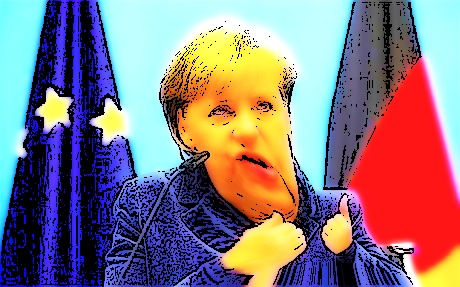
 Das Merkeschauble
There is no way through the minefield for hasty EU integrationists and demanding bond markets. The world is on schedule for the worst economic crisis in recorded history.
The big issue at the moment for any intelligent observer of the EU mess (and the Sino-American reactions to it) is not ‘where will it all end?’ – because frankly, nobody on the planet knows that for certain. No, the big question here is “Do some or all of the players know what they’re doing, or is it just more headless chicken stuff with no direction known?”
This requires some calm analysis, not simple reportage…although to be fair to any commentator at the minute, highly significant events are happening so quickly – and accelerating exponentially – one almost has to report and analyse and project on the go. But do that for too long, and the result is plot-loss.
There are two ways, I think, of interpreting the two surreal developments running side by side as I write. The first is to see them as a form of collective madness flavoured with a generous dollop of blind panic. In this scenario, the MerkeSchauble, a German animal obsessed with the concept of hardline EU integration, is spatting with the Lendymeerkat, a possibly mythical beast seemingly hellbent on devouring every EU member State. For the Germans, the only thing lying at the end of the road is a ginormous bill. For the lenders, the only things left at the end of the road will be heavily-dented cans. What, then, is the point of it all?
Part of me thinks there isn’t one: there really is an attack of jerking knees taking place, in which the two wild animals involved are reduced to their comfort zones – bossing other folks around, and making money whatever the social cost, respectively. But this doesn’t explain any more than, say, 25% of what’s going on.
For example, Germany is setting off a wholesale transfer of power to Brussels – not Berlin. The result will without doubt be a Europe largely run by German fiscal discipline, but not necessarily one of German ‘power’: such an EU could never work anyway…..the Germans don’t do the gentle hand on the tiller.
I covered over the last few days how the medium-term plans of the MerkeSchauble are now steadily more apparent, but although their approach is fundamentally anti-democratic, this is nothing new in the EU. And again, the German people, judiciary and many bankers have grave doubts about what the duo are up to. We are not witnessing a million upraised arms beneath the Siegessäule as Angolf Merkler salutes from an open car: this is a dash (ill-conceived, but with good intentions from their viewpoint) to make the EU safe from the ravages of international speculation.
On the other side, the markets (while they are, as usual, being cannibals) clearly have no long-term interest in burning Europe to the ground. First up, the EU is a crucial market for them; and second of all – destroy everyone, and it won’t be a haircut they’re taking, it’ll be every last strand of hair falling out. As you may have gathered by now, much of the time when we say ‘the markets’, we still mean ‘the Americans’.
This is why the US fears a eurocollapse so much: while the anarchy at present gives the aspiring two-termer Obama yet another excuse for having been useless, out here in the real world the American Establishment knows only too well that a run on its banks would turn the obscene sovereign debt problem into a disaster.
So if it’s not for power and easy money, then what is it for?
Look across the lunatic fringe of financial blogs, and you’ll observe the conspiracy nutters working overtime on this. I’m not sure this is any kind of conspiracy; it’s more a sort of rough, make-it-up-on-the-hoof plan.
What the US has done over the last nine months is dump France as the place with whom to do business. America has piled in behind Berlin – up to but not including the money thing, much to Schauble’s chagrin in Wroclaw. They did this because (1) the French couldn’t run a fiscal budget to save their lives (2) Sarkozy – their ‘man’ – is going to lose bigtime and (3) the Germans at least have the track-record of determination to save the show.
The markets – very much with Geithner’s blessing – have taken the view that, without constant 24/7 harassment and vicious attacks, the eurocrats will be too smug and dumb to get their house in order. They also figure that the worse they make things, the more easily Germany will be able to persuade the eurozoners to fall into line. Being just as amoral as the Fed and the White House, the markets want a stable, strong centre to a unified Europe…with one ‘thing’ they can point at to say “So then, you’re the guy who pays the bill”. At the moment, the PR in favour of this being the ECB is non-stop, and costing somebody (probably the Fed and/or the CIA) a fortune. Mario Draghi will resist this, and he should indeed do so: central banks are, in the end, the holders of taxpayers’ money. They are not there to give lenders an easy mark. The Germans are very strong on this point…..something that is, not surprisingly, causing friction between Berlin and Washington.
But the Americans will think twice before they anger the MerkeSchauble. Geopolitically, a strong EU remains a potential bulwark against the megalomaniac on the other side of the Urals. And financially, they will be dead soon after the arrival of any debt Tsunami from an EU implosion.
So that is my thumbnail sketch of ‘what’s going on here’. It isn’t a Zionist Elders conspiracy construct, because it isn’t a conspiracy. It’s an outline road map containing the possibility for diversions here and there, but with a common goal: an integrated Europe. The Germans and the markets/Americans are both working towards the same goal; it may look as if they’re at war, but they’re both doing some mach schau in order to encourage the shirkers.
But if we can’t give an answer to ‘where will it end?’ yet, we can probably suggest the odd obstacle to its achievement. As in, a dozen Beecher’s Brooks in a row, all lined up and ready to break the neck of the foolhardy jockey.
By far the biggest of these, for my money, is France. Having failed to get a shovel into either the EFSF or the ECB, and having watched as the world showed zero interest in the leveraging bazooka, all they’ve done over the last three weeks is sink deeper into the doo-doo. I remain of the view – first expressed here following the EFSF rows leading up to the GdF – that if the Gallic banking fall-over can be contained, this suits Berlin perfectly. France can bail out its banks and remain afloat, but it’ll have taken one mother of a torpedo amidships. This will relegate Sarkozy’s country to the second rank, and force her to do Germany’s bidding. But if the ship sinks, then Germany’s plans are, basically, ruined. So my prediction is that, when push comes to shove, Berlin will keep Paris afloat. What it won’t do is buy the French a new engine. (I think the rumours about a north-south Europe divide reflect another of the options being held in reserve, just in case the Sorbonniers throw all their toys out of the pram.)
Next up – and they’ll probably happen first (just) – are Greece, Italy and Spain. Spain has remained below the radar for a while, but that is now changing. I often find it amazing that more financial commentators haven’t done the sums about how Spain has got this far in its attempts to remain solvent. Madrid has hocked everything – and I mean, everything – to plug the breached dam, but sooner rather than later it will have to borrow just to pay the wages and the pensions. The bond markets simply aren’t buying Spain’s offers at the moment. As in, not at all. And as Warren Buffet says, “Debt ain’t a problem till the money dries up”. Spain is in a hopeless situation.
Italy is a madhouse at the best of times, but there is nothing madder than the markets claiming that reforming its economy is the way ahead. It will be eventually, but this was just an excuse for traders to keep the pressure up. (The previous week, they wanted Berlusconi out; then when he went, they sold because he wasn’t there. That was such an obvious case of the agenda slip showing, I’m staggered that more people didn’t pick it up.) The simple fact is that at these prices, Italy now has no way back. The vicious circle has begun.
This too will blow a big hole in the MerkeSchauble’s advance column – be it Greece and Italy, or them plus Spain. Because either two out of three then gives the German-American Bund a tough decision to make: do we now plough in with big, big bailout funds? Not only would both of them shirk that responsibility, neither of their electorates would let them do it anyway.
The third potential problem may well in the end make all the others academic by comparison: social unrest. The Greeks just look knackered at the moment, but there will be a general strike after Christmas. The Italians are fresher and feistier. And once the Spanish people see how things are panning out, they’re not going to lie down and be raped: it’s not in their nature.
There’s no need to stop there, either. Does anyone seriously imagine that the inevitable decision to strip France of its CAP scam is going to produce any less than blocked autoroutes and a succession of strikes? Of all the EU member States, France is the one that has been living furthest beyond its means, and the culture quickest to turn truculent if its aims are frustrated.
A selection of the above would create so much economic mayhem, the EU would disappear up itself within weeks. Yet in all honesty, I think there is barely a eurocrat or banker in the world that has given this likely eventuality a moment’s thought. In the West, we have become sanitised over three generations to the idea of massive socio-political upheaval. The mistaken conclusion shared by most dealers and traders – that the past is any guide to the future – applies just as much in the cultural sphere.
Everything from there onwards is speculation. The markets are playing with fire, and the odds are heavily on them getting first degree burns in the end. And Berlin’s gamble has, in the above context, no more than a 1 in 5 chance of success.
That being the case, by next Spring the US will be showing some clear signs that recovery may, in the wacky world of Bernanke, be possible without jobs; but even there, it isn’t without export markets. A massive inflow of bad debt at that time would sink the Fed in short order. Not even the Fort Knox gold could cover a debt 42 times bigger than its alleged gold content’s worth.
All this could be avoided – as The Slog has argued from the start – by broadscale, planned mutual debt forgiveness – coordinated by the G20, and accepted by the world’s banking institutions. The G20, however, is a sick joke that makes the League of Nations look like a decisive body by comparison; and the banks remain the banks: convinced that they know better, and must triumph in the end.
However, I think the main reason there will be no solution is the dearth of messianic, inspiring leadership anywhere. There may well be someone waiting in the wings, but I’ve yet to sniff his or her scent.
It certainly isn’t Rick Perry or Nigel Farage – two blokes whose combined intellect wouldn’t fill a rat’s nostril – and it quite definitely isn’t David Cameron.
Dave is off to Berlin this Friday. His irrelevance to the unravelling eurozone ball of wool is so complete, he makes Neville Chamberlain in 1938 appear like a chap with the whip hand at Berchtesgarden. At least Hitler respected Britain. Angela Merkel doesn’t care a fig either way about Albion: she has other more important things to think about.
 The Slog