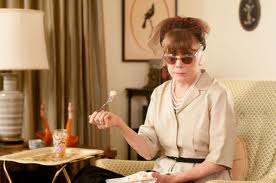
 Sissy Spaceck as Missus Walters
‘The Help’ is a film version of Kathryn Stockett’s 2009 novel about race relations in early 1960s Mississippi. For me, it is a movie about dignity, and the wonders of aspiration that come from that: it reminds the viewer that, without respect for self put towards an unselfish end, there can be no progress. Above all, it is a wonderful film.
That wonderful can still be commercial is evidenced by the fact that the picture cost around $25m, and recouped its cost during an opening weekend in which it took nearly $27m.
To be honest, I went a little in fear of it being just another pc-preppy East Coast liberal glorified view of The Noble Black Person Who Can Do No Wrong. But that’s the last thing it is. Everything from that Deep South era – the imperfections, the marital violence, the daily lip-biting in the face of monstrous bigotry, the shaming capacity of naked fear – is on show. I went to the Deep South once – and only very briefly – as a young and idealistic man. Back then, just being white with long hair was a near-capital crime: I have only twice since been more scared for my own safety. In the 1961-4 Civil Rights period, even having thoughts about being “an uppity nigra” was enough to keep the bowels regular.
God knows what it was like to be a black maid with ambitions to set right racial injustice down there in the early Sixties, but this film will help anyone who sees it to understand both the terror and determination that went with that. Had it done this alone, the film would merely be Mississippi Burning or To Kill a Mocking Bird. But where The Help scores is in telling a social tale of ignorance with great sensitivity, 20:20 observation, and irresistible humour.
For this movie isn’t a two-dimensional black and white picture: the colour is in far more than the beautifully photographed print. Everything about a long-Gone with the Wind Saar-yeth is in there: the braindead Stepford women, the white trash, the keeny-eagerness with which racism is fostered, the astonishing sexism and ruthless class distinction, the stifling heat and suppressed desire, the wisdom, myths, stupidity and – overlaying everything – the sense among the Whites that something must not be allowed to end….the same something that most Blacks felt would never end. It is in this last context that the genuine ability of special individuals to think beyond the mores shines through. The personal growth in the denouement comes from the most unlikely quarters, but is utterly believable.
It’s hard to know where to start on what there is to enjoy in each of the many levels of this film. Starting with the sad movie-wonk stuff, the direction is inspired, the casting near-perfect, and the props enough in themselves to have me gasping at the stuff I only saw in mono newsreels brought to technicolor life. Some of the performances have Oscar stamped on them – and top of these would be Sissy Spaceck as the villain’s mother Missus Walters. If she doesn’t get the Best Supporting gong next year, then there is no justice….and the same goes for the costumier on this film. It’s a funny thing, but when she was a skinny eccentric American-freak cliche, Ms Spaceck never did it for me. In this film, she did everything and more. While this may be a reflection of my advancing years, that shouldn’t detract from her acting achievement in this film: to portray dementia as funny – and yet remain true to the inner soul of her character – blimey, that is acting of the highest intelligence.
As I opined at the outset of this review, The Help is about dignity and aspiration. For me, there are whole swathes of our white underclass, obsessive feminists, self-pitying ethnic minorities and demanding Islamists whose balance has been destroyed by a British State determined to patronise them while performing a dignityoctomy. I’d love to think they could go and see this movie, emerging afterwards to understand why nothing strived for is nothing gained. At the moment, I doubt very much if any of them beyond the instinctively smart minority would ‘get’ that dimension to this flick. Hopefully, in time, a revitalised generation made more real by the ravages of poverty might manage it.
In the meantime, I’d recommend The Help to every spectrum of political and socio-economic opinion. The very fact that it tackles the issue of cultural difference head-on would be an excellent slap across the face for everyone from David Cameron to Harriet Harman.
I very nearly wrote ‘wake-up call’ then. Perhaps I am losing it.
The Help, Written & Directed by Tate Taylor, photographed by Stephen Goldblatt, released August 2011.
Starring Emma Stone, Viola Davis, Bryce Dallas Howard, Octavia Spencer and Sissy Spacek
 The Slog