
There’s an interesting trend in the US Big Multinational Business sector at the minute: rather than issuing shares to raise money, senior executives are buying back their publicly quoted shares to increase personal stakes in the company. I’m told that, as a result, the sheer volume of stock market shares actually on sale in America hasn’t been this small for three years.
At least three sites I went to the other day proclaimed this as yet another sign that the US has turned a corner, and thus senior corporates are showing massive confidence in their own futures. Oh dear.
Let me give you my take on this, and see if anyone shoots it down.
American Big Business has had nearly four years of Zirp and cheap bonds with which to borrow, buy and make money. When free money is raining down from the skies, you don’t need more stockholders to dilute your share-action. You just need an upside-down umbrella. Big multinational corporations have the highest mountain of money in their vaults since 1959.
When fears about the global economic future have – despite near continuous QE to pump up the Dow – kept stock prices low to falling in real terms, then that’s a good time to buy…because the theory goes that it can’t last forever, so buy now before the next boom.
As I posted five weeks ago, there are also a number of large multinationals (and associated investment bankers) eyeing a Europe that may well be a veritable theme park of cheap assets in a year’s time. Thus, buy the holding company shares now, watch their real value increase when the business cycle motors up again in Europe. (Even before the cycle goes up again, the shares will be worth more, because analysts and myopic share-tippers will tell the punters they’re an undervalued ‘buy’).
The flaw in this thinking is, in my opinion, the idea that things will soon return to normal. What is deemed ‘normal’ times by American MoUs will never return. So an awful lot of company executives are going to lose their shirts if they leave it too long before selling their ‘undervalued’ shares.
But the move has nothing to do with confidence, and everything to do with greed. And the process as a whole is what more and more observers of this model of capitalism are beginning to call ‘The Disconnect’.
—————————————————————
 I use the heavy emphasis above there because I am truly fed up of the business (and business media) Establishment’s feeble attempt to suggest that all those with doubts about globalised mercantilist zero-sum derivative-knackered and socially-destructive capitalism must ergo sum be Hairy Greenpeace Commies with a barely hidden agenda. Trying to ‘frame’ opponents in this derogatory manner is a sure sign that the System has run out of sensible defences, but it is also a big part of the denial surrounding The Disconnect.
What does the term mean precisely? For me, it consists primarily of people carrying out commercial activity – or seeing trend signs – which they swear blind are evidence of the economic system displaying an ability not only to correct itself, but also go on to greater things thereafter. The daftest soundbite yet invented by this tendency is ‘the jobless recovery’. That’s no different to calling a bad play ‘the empty theatre’. But in coming up with such tosh, the supporters of our free-markets-gone-potty capitalist form illustrate what The Disconnect is: a complete misreading of the horse/cart arrangement.
Here is a simplified, traditional description of how business, society and government interact:
‘Banks exist to provide capital support loans to businesses and home-makers. Manufacturing and service commerce exists to create real wealth and gainful employment, thus contributing to the greater good of a developed society. Retailing exists to be a form of distribution – offering choice and value to the customer, and cost-effective access to that customer for manufacturers and service providers. At a local level, it also adds markedly to the sense of community, and facilitates social intercourse. Government exists to help protect the citizen from crime, foreign invasion, and undeserved poverty. Government may also, at times, fund public works for the social good. State-owned industries exist to provide vital social services without unnecessary cost to the taxpayer. Mutual societies and Trusts exist to supply services to middle income or poorer families, and remain safe from takeover by asset-strippers. And trade exists to make money on surplus goods we produce, and import those things we cannot – for various reasons – provide for ourselves.’
Up until about forty years ago, that description would have fitted neatly into any primer on O-level economics. Some views on specific items have changed dramatically since then and for the good. Several of them were natural progressions as technology changed. But some of them are absolutely fundamental to continued health…..and these are being perverted by The Disconnecters.
Let’s start with perhaps the most obvious example: manufacturing companies exist to manufacture. They survive and prosper by developing new products, improving the performance of existing ones, and developing new markets. But large multinational companies aren’t doing any of these things at the moment.
 What they’ve become instead is investors in US Government debt. This has enabled them to build huge cashpiles and donate these to grateful shareholders….which puts the share price up and keeps the Dow high – thus, everyone’s happy. Except the workforce, because far from creating jobs, this mode of enterprise tends to cut them. It removes the need to develop new markets, because one simply uses the cash hoard to buy ones that are already in there. That too cuts headcount after the acquisition….and creates no new jobs at home.
Did anyone see the General Electric results this week? I guess with GE, the clue’s in the name, right? And GE this morning has relatively happy shareholders, because the company announced a 3% rise in earnings per share. But as Reuters correctly observes, ‘thanks to another strong performance at GE Capital, its finance division.
GE is not a healthy company innovating in electrical goods and thus continuing to make stuff people want: it’s a company run by semi-autistic accountants who got themselves a money-machine, and then folded it neatly into the reporting data. They did this because they could, because nobody wanted their shares to decline, and because remote, faceless shareholders were wound up to expect this by equally myopic analysts. The giveaway is in this insouciant Bloomberg observation on GE’s results, ‘The growth came as revenues from [core] operations fell short of analysts’ average forecast, with a 4% rise to $38bn’.
4% growth in a recession, and revenues of 38 billion bucks – and these jerks were going to be disappointed? That is The Disconnect, my friends.
Another equally massive (and obvious) trend: banks (and the financial system in general) now put themselves before capitalist business or social stability. Indeed, most of the big players don’t even think about doing otherwise. But productive business, and the citizens they employ, and the real wealth they create, are the only reasons to have banks in the first place. Banks are there to finance growth, risk, and property ownership.
Today, the banking system has the political class – and economic theorists – in such a degree of thrall, nobody wants to talk at all on the subject of it being arse-about-face. Banks by definition cannot create real wealth without debasing currencies and inflating the value of commodities. Some would disagree with that (and with certain assets there is the odd exception) but to do so is to split hairs: there is a thing called ‘the derivatives market’ and its ‘value’ is ten times that of the global economy. But is is virtual, notional, and unreal: to requote the old Jewish phrase, it’s for buying and selling, not for using.
 But the problem is that one day – when another daft idea has come to roost – a financial institution or investment group will want to use the money in the ethereal realm. Then, somehow, it has to be made real. But it can’t be. So we have to get the printing presses out, or let the banks concerned fail. The printing presses win every time…..and bear in mind, we aren’t even at this stage of the financial meltdown yet.
The stage we are at is of deficit economics and cheap money having helped put banks in the driving seat of a vehicle they think is a private jet – whereas in fact, it’s the biggest tanker on the planet….and if it sinks, the pollution will be awful. The EU debt crisis is the best example in history of where sovereignty, citizen welfare and business recovery are all being put an equal and very poor last behind the salvation of the banking system.
I’ve posted this before, but it bears repeating: with the money – taxpayers’ money – that has been handed out to private Ezone banks as ‘liquidity’ by European and other central banks, we could easily have forgiven both the original loan capital lost by the banks, and the unrepayable debts owed by many EU member States – not all of whom by any means are ClubMed countries.
When Merkel says debt must not be forgiven, she is naively playing into the hands of bankers. That remains a tragedy, but think about it: because banks had gone target-silly, and politicians were being persuaded by eurocrats and Presidents to dive into a cheap money pot, the citizens must not be forgiven. It is a three-card trick of quite stunning chutzpah.
I accept that lots of retail-centric idiots wanted their therapy, and that we are all to blame in some degree or another. But somebody needs to explain to me why a £25,000 credit card debt (for an individual whose net worth is £750,000) plays anywhere near a banking set that lent twice the gdp of a nation in at least three instances, and gave mortgages to folks who could barely add up the numbers on their dollar bills.
Where banking went wrong was to see itself unconsciously as a maufacturing business. It still does: Bob Diamond at Barclays continues to jabber away like some demented chimp about how he neither wants nor needs a retail system. Robert darling, we don’t give a flying f**k what you want….citizens need a money transmission system – and even if that goes entirely online, it is still your socio-economic duty to provide one. Or get out of the business.
The system has manufactured $300 trillion of notional wealth which a lot of people very soon are going to want to convert back into real money that simple doesn’t exist. And while the magma underneath this thin crust of make-believe is busily building up to the biggest Krakatoa of all time, entrepreneurial business can’t get any real money at all.
That is The Disconnect. And when you Disconnect justified banking speculation from healthy capitalist accumulation, then capitalism can’t regenerate or thrive, citizens can’t get jobs, and society degrades until – at some point after the last can down the road – there is a revolution. However, the remote-shareholder construct per se helps to accelerate this process.
Remote shareholders are a Disconnect in their own right. At the moment in the UK, a good thing for UK comms software manufacturers to be investing in would be TV/pc/mobile/android connectivity improvements. Another would be cyber-surveillance, where we are being eaten alive by Asian blaggers and malign foreign security services. There are hundreds of sectors like this in Britain, but the expansion of Bourse listings over the last forty years ensured that short-term shareholder needs usually came before investment. (An important reason behind the superior German performance is that publicly quoted companies are a much smaller proportion of all commerce there compared to the UK).
So The Disconnect is also between the future of a more solid manufacturing base and institutional investor frenzy. But this in turn is because The Disconnect also applies to those insurance, assurance and pension companies who went ‘bancassurance’ after Big Bang…with disastrous consequences, huge losses, and an eye taken firmly off the ball of providing citizens with the protection they need against life’s imponderables and outcomes.
——————————————————-
On and on it goes. There is a Disconnect between the diversification out of groceries by the multiple retailers, and community spirit. A disconnect between highly-paid and televised foreign football stars and the development of the indigenous game here. A Disconnect between ‘retail recovery’ in the US and the American trade deficit crisis.
It can be succinctly summed up as ‘losing the plot’, but that phrase is done to death, and no longer has any shock-effect on us. Like ‘he just doesn’t get it’, ‘outside the box’, and ‘Our aim is to be a World Class organisation’ it makes thoughtful people want to groan and/or vomit. It is in fact true to say that those who talk of losing the plot have themselves forgotten what the consequences of losing the plot are.
That’s the significance of The Disconnect: it is a symptom of a disease. And that disease is doing what ‘I’ want to do as opposed to what the best approach might be for the greatest contentment of the greatest number in society as a whole. It is equally apparent – and just as dangerous – outside the econo-financial sector. The police senior ranks think sucking on pc tripe is more important than making people feel safe. Too many social workers think their job is a turf war between them, the nursing profession, and the relatives of the problem family member. GPs increasingly feel that running a business is more important than healing the sick. Senior ranks in the fire service think having their full quota of women members on frontline duty is more important than fire prevention.
 Probably the greatest – certainly the longest-serving – British Disconnect is Whitehall. The pension, the Gong, the new office building, the clean copy-book, the creation of bigger empires, and the retention of the budget are infinitely more important to these senior wasters and incompetently uncommercial nitwits than, say, the right equipment for our armed forces, the right investment in hospital technology, the reduction of the national deficit, the assessment of European geopolitics, or how many mad mullahs we have wandering about claiming benefits they shouldn’t be getting.
And finally, there is perhaps now an unbridgeable Disconnect between Westminster and the majority of voters – illustrated easily enough by the reality that 2 in 5 of the electorate never vote. This ‘bubble’ is in turn kept afloat by the grubby influence of powerful media and lobbying interests….but again, entirely for their own ends. 3 in 7 of all House of Commons visitors last year were professional lobbyists. When I attended a demo there by peaceful Libertarians three years ago, the cloakroom attendant took one look at us as we filed past him into the Visitors’ Gallery.
Turning to a security officer, he asked “Oo the bloody ‘ell let this lot in?”
That is the Disconnect.
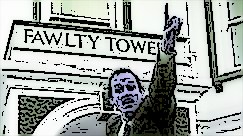 ‘Look, I’m trying to run a hotel here, and you bloody guests are getting in the way”
 The Slog