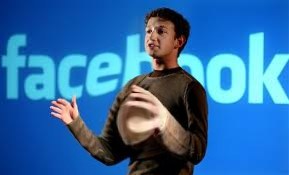
 Zuckerberg…all heart or all wallet?
To call Mark Zuckerberg precious would be like calling Chris Huhne an amnesiac: somehow, it doesn’t quite capture the depth of hypocrisy involved.
The guy presents himself as altruistic, telling us how ‘Facebook helps you connect and share with the people in your life.’ Whereas what Facebook actually does is share tons of information about you with large multinational advertisers. ‘It’s free and always will be’, preaches the site: but the only reason it’s free is that – in the age of digital marketing – marketing clients of the site use it to trace what your interests are, where you shop, what you buy, and who you know. And it isn’t free for them: for them, it’s priceless.
Zuckerberg is also keen to tell us how he’s retaining ‘control’ of the company – as if this was a way of remaining pure while he trousers $30 billion. But the truth is, he’s a control freak – and unless you want to see your equity’s value disappear, whether you sell 30% or 70% is pretty immaterial: you have to do what the money-men want.
Before anyone fingers me as Mr Resentment by the way, let me make it clear that Zuckerberg had a great idea, the model for which originally had very little to do with business. That said, he was always going to make a pile of money out of it: and at that level, I’d say good luck to him. What he didn’t grasp at the outset was that his ‘higher order USP’ (modernising the staying in touch thing) was more compelling than Google’s. It may well lack Google’s staying power, but that’s another story: what Mark Zuckerberg stumbled onto was what the direct marketing business had been seeking for years.
Fifteen years ago, I worked on the Safeway account (it’s now Morrisons) and so was in at the start of what became known as CRM – customer relationship management. Although I had qualms about the wholesale collection of customer data via loyalty cards – another idea positioned as a reward, when it is actually of way of selling your privacy far too cheaply – I rapidly became convinced that very few people want ‘a relationship’ with a supermarket or a car showroom. Further, the only clue marketers had was what the Supermarket (or whatever) till receipt told them. This led once to a hilarious project to discover why certain customers weren’t buying meat in the store. In the end, a couple of focus groups made it crystal clear: they were all vegetarians.
Facebook changed all that for good. Now suddenly, by changing the model from one of supplier relationship to advertiser mining of a social network provider’s data, every form of ‘affinity marketing’ was possible. About five years ago, I posted that giving away confidential data on Facebook was ‘like letting Big Brother in through the front door’.
I use Facebook myself. It is indeed an excellent way to stay in touch with friends, and it’s also a good way to get hits at The Slog for posts where I think my circle will be interested. Yet although my own profile gives very little away, analysis of who I know and the comments I make remains invaluable to marketing people. Making any comment at all gives access to programming code – the cookies used to identify what sites my pc has visited. I’ve taken to erasing cookies on a daily basis, but the buggers still log them.
Some time ago, I put all the personal liberty issues surrounding Facebook to a couple of senior politicians. They both had the same reaction: “If it’s free, why should you complain? Facebook is providing a service, and this is how they make money”. These days, I know better than to even bother with what the political class thinks. Most of the time, it doesn’t think at all.
However, my issues with Zuckerberg’s brainchild are somewhat larger now that the Great Young Hope has decided upon an IPO. In my opinion, the valuations being talked about for Facebook’s public launch represent the wish-fulfilment of those desperate to keep the current cock-eyed model of capitalism chugging anti-socially along. There are three reasons I think this:
1. The ratios of revenue to valuation are entirely out of whack. At $3.7bn of revenue at the last count, the expected valuation of around $80bn represents a PE of over 20. That doesn’t compute in this, the newly emerging age of valuation reality.
2. Facebook is putting a billion dollars to the bottom line on that revenue – over 25% on the gross. The idea that – as new online media concepts come along, and Asian social network competitors grow – the company can retain such margins is simply ridiculous.
3. Like many before it, Facebook has gone from Next Big Thing to New Kid on the Block to Global Phenomenon. But the ageing process for new phenomena has been accelerating at an exponential rate for several decades. There will come a point in the time – and now, money – starved lives of the working population when Facebook’s appeal will fade. Twitter’s much briefer (and more widely broadcast) potential for comment has, I think, already integrated far more intimately with mass media than Facebook.
The ingenuity of Mark Zuckerberg is to be applauded for bringing to people new ways to stay close in an increasingly distant world. But its commercial development and then public flotation erodes liberty, and offers a promise to investors that cannot be kept. I’m sure its IPO will be very good for the tax revenues of California; but on the bigger canvas of personal privacy and investment value, it is an unacceptable form of capitalism.
 The Slog