The last thing the IOC’s choice of Tokyo as an Olympic venue demonstrates is 2020 vision
September 8th 2018
The IOC opened an entirely new chapter in the history of the Olympic Games last night when it announced that the 2024 Olympic Games will take place underwater, off the coast of the East Sinai Peninsula in Egypt. Known locally as The Blue Cemetery, the Olympic village will be built in a submarine pothole that reaches over 426 feet into the depths of the earth. It’s best known for the astonishing number of diving fatalities that have occurred there, having been deemed “The World’s Most Dangerous Diving Site”. “We chose to site the games here so that all humanity can share the experience,” said IOC spokesperson Mia Bonkeras-Locazione, “and secondarily to minimise the number of fatally irradiated athletes. As always, the IOC’s key priority is to create the perfect conditions and ultimate in safety for the athletes, several of whom are still alive following the unforseeable nuclear tragedy of 2020”.
Herr Braned Eyedeah, head of Marketing at the IOC, told the world’s media that East Sinai’s submarine location won out on the final shortlist “because it offers unparalleled facilities for all the swimming, diving and new Olympic events such as synchronised lung-logging, Bends Barrelling and Flipper Formation Rugby.” Asked how track and field events would be staged underwater, IOC Chairman Bernt Bridges firmly dismissed doubts by asserting that “part of the Olympic challenge has always been about adapting to the conditions of any given location, and we are confident that human ingenuity will win out, while allowing for affirmative action on behalf of new competitors such as dolphins, coelocanths and giant squid. Also we must be pragmatic in these difficult times, and take account of the stable political situation in Egypt, as well as the generous contribution of $4.7 trillion made by the Arab League”.
Games Security will be handled by the Muslim Brotherhood, in association with Hell’s Angels.
The two other front-runner locations alongside Blue Cemetery were Java and Haiti.
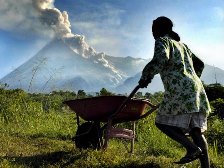 Mount Merapi (left) on the Indonesian island of Java ran Sinai a close second. Smoke pumps out of this volcano’s mouth more than 10,000 feet in the sky on a daily basis, and “Fire Mountain” (as its name translates into English) has erupted more than 60 times in the past five centuries, most recently in 2006. Before that, a 1994 eruption sent forth a lethal cloud of scalding hot gas, which burned 60 people to death. In 1930, more than 1000 people died when Merapi spewed lava over 8 square miles around its base. “It would have been perfect for the molten lava wheelbarrow hurdles, offering a ready supply of raw materials” commented Bonkeras-Locazione.
 The IOC also thought long and hard about Gonaïves, one of Haiti’s five cities totally washed out to sea by the hurricanes of 2008, as an excellent location for the high jump, plank walk and obstacle marathon events. In 2004, the city of 104,000 took a severe beating from Hurricane Jeanne. Three thousand Haitians died when the Category 3 storm hit and leveled large swathes of the city. What makes Gonaïves so susceptible to destruction by hurricane is its position on a flood plain that’s prone to washing out when inland rivers swell. It is thus a flexible destination where it would be easy to hold swimming events in the sea, or on land, depending on the disaster involved. During the Monsoon season, the deforested hills around Gonaïves melt away and mudslides nearly bury the city. “This would’ve been of great use when constructing makeshift stadiums if and when the building programme fell behind schedule” said Herr Bridges.
Late Flash: FIFA turns down Scotland as World Cup venue on grounds of porridge health-scare shock
Last night at The Slog: Lackbladder goes forth into optimism overdrive
 The Slog