“Western core challenged and weakened,” El Arian tells central bankers
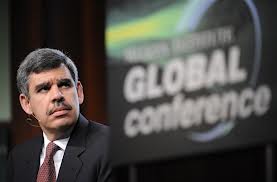 Mohammed El-Arian….outspoken
PIMCO’s Mohammed El-Arian just made a potentially mould-breaking speech to an audience of senior bankers (gathered in a central bank) to say, basically, the central banking’s role in economic and monetary policy is no longer cutting it, and lots of “other private and public entities” need to get their knees brown by doing a lot more.
I have long been an admirer of El-Arian, a bloke whose output I always read….and whose bravery I applaud. As a thinker and policy formulator, he is more than ready to stop tinkering, and accept the need for radical change to the current form of capitalism. What caught my eye in the transcript of his latest public statement, however, was this (my emphasis):
“There is a real question about how the overall global system will evolve. Most agree that its Western core is weakened and multilateralism is challenged. As a result, the system is likely to struggle to accommodate the development breakout phase in systemically important emerging economies….”
Now that might not read like hold-the-front-page stuff, but in my view it is. What the PIMCO boss is doing here is to raise a large question mark against what he refers to as “a uni-polar global system”. He ends his next passage in the speech by saying “What is yet to be seen is whether the outcome will be a bumpy transition to a more multi-polar global system, or the healing and re-assertion of a uni-polar one.” He is hinting, I think, that we are going to have multiple poles, rather than Levitt’s infantile ‘Global Village’ concept.
It’s nowhere near everything I want, but it’s a step in the right direction. And it is another tentative sign that the most original thinkers are beginning to doubt whether globalism isn’t in fact downright dangerous in the geopolitical sense – and dysfunctional in banking or local socio-market senses. I have many strong arguments to offer against globalisation of markets (use the site search engine to read all 13,208) but my main two are very simple. Number one, it clearly doesn’t work for anyone outside a tiny minority of multinational concerns who use it to save money and evade tax; and number two, it is a view espoused by those whose consistency in the art of being wrong is unchallenged. Here names like Brown, Mandelson, Cameron, Balls, Barroso, van Rompuy, Bush, Dimon and Sarkozy spring to mind.
Although the old media are as ever largely behind the curve on this question, events are already unfolding (or unravelling, depending on your view) to show that Big = cumbersome, and a global balance in the era of rapid Asian industrialisation are vital factors arguing against the globalist view. This latter is what El-Arian means by its “struggle to accommodate the development breakout phase in systemically important emerging economies”. But the supertanker model of large ‘poles’ will also in time, I believe, break down the system further beyond Mohammed’s preferred route.
There are three huge examples which present themselves in this context: the USA and the complexity of its market and fiscal systems (of which, more later today); China and its huge variety of cultures impatient to benefit from the Great Leap Forward; and above all, the European Union, whose single currency will damn it to destruction unless somebody with an ounce of humility steps in to abandon what was always a crazy idea.
However, one should not forget the rambling and erratic nature of the Russian Federation – a cobbled together country massively overdependent on energy exports in a depressed world economy, and already run in several regions by semi-feudal billion Raubritters; or indeed some of the larger Brics like Brazil and India – whose success now looks less certain in the light of the gathering economic storm. What we have here is lots of Uniteds and Unions and Federations morphing from loose to falling apart under the strain of east-west wealth equalisation. (You will find many in Spain, even, who think splintering is likely there too.)
In the East itself, it’s time to stop using the collective word ‘tigers’ as if Asia was somehow one society. The growing enmity between Japan and China is all the evidence we need for that, but don’t forget the competition between Korean, Thai, Indonesian and Chinese workers to be low-cost providers to a west where consumption is shrinking alarmingly.
One thing history teaches us is that periods of great upheaval very rarely produce smooth transitions – be they social, political or economic. We are obviously at the starting point of just such a period, only this time with the added element of unpredictability always inherent in rapid technological development. The idea that some kind of ‘world’ system is going to emerge from that intensified rate of change – and competition for less and less volume – is beyond silly. Nations will reverse back across the drawbridge….and they will be right so to do.
 The Slog