We are seeing a seismic shift in the public mood about Fuku-fracking
 David Suzuki is by any measure an acomplished, respected and eclectic scientist. Judging by his overall comments in relation to Fukushima, he is also a bloke with a healthy dollop of common sense. Questioned recently about the threat from existing radioactive leaks to north American fish, he had this to say:
“…eating West Coast fish is safe.Trace amounts of radioisotopes from the Fukushima plant were found [in bluefin tuna off California’s coast], although the best available science puts them at levels below those naturally occurring in the environment around us.The most comprehensive health assessment, by the World Health Organization, concludes radioactive particles that make their way to North America’s waters will have a limited effect on human health, with concentrations predicted to be below WHO safety levels. I’m taking a precautionary approach: fish will stay part of my diet, as long as they’re caught locally and sustainably, and will remain so until new research gives me pause to reconsider.”
Don’t you like this man already? “This is what the data shows – but just in case, I’m going to be careful. Then I’ll see what the new data looks like”. If only the climate change debate could be like that, James Delingpole would be out of a job, and Britain might have a balanced energy policy.
In 2004, Suzuki was voted Greatest Living Canadian in a CBC poll. He was awarded the Right Livelihood Award in 2009, and has been an award-winning environmentalist and geneticist, as well as being an accomplished science broadcaster. This is what he said two weeks ago in Alberta about the Fukushima situation:
“Fukushima is the most terrifying situation I can imagine. You ask, what can we do? First of all you have got a government that is in total collusion with Tepco, they’re lying through their teeth. The fourth [chamber] has been so badly damaged that the fear is if there’s another quake of a 7 or above that that building will go, and then all hell breaks loose. And the probability of a 7 or above quake in the next 3 years is over 95%. They don’t know what to do. We need to get a group of international experts to go in with complete freedom to do what they suggest. Right now the Japanese government has too much pride to admit that. I’ve seen a paper which says that if in fact the fourth plant goes under an earthquake and those rods are exposed, it’s bye-bye Japan, and everybody on the West Coast of North America should evacuate. Now if that isn’t terrifying, I don’t know what is.”
Although something of an activist about certain elements of “the responsible use of science”, Suzuki isn’t an eco-nut: he prefers facts to assertion – and then uses his biology expertise to reach a conclusion. But what he and others are now beginning to highlight about the unsafe use of science is NOT that the science is intrinsically unsafe, but that human corruption makes it so.
 This is an absolutely vital point, and one that the Rightists Hannan and Delingpole tend to gloss over. Although made in 1974 (nearly forty years ago now) the generally crappy Irwin Allen celeb-movie Towering Inferno was nevertheless very prescient, in that it showed why a building that should’ve been safe wasn’t….because of crooked contractors. In the cases of both Fukushima and Fracking, this is really what lies at the heart of the story.
There’s now little doubt that GE designed the Fukushima plant with cost and margins in mind (two scientists on the project resigned in protest about it) while some of the functional elements themselves are difficult to explain – it’s height above the sea, the location of the water cooler and so forth. But equally, both the Abe government and Tepco deliberately underplayed the danger.
They did so in order (1) not to damage Japanese exports and thus make a bad economic situation dire; and (2) so as not to harm their chances of winning the prized Olympic Games host award. Exactly why it is prized continues to elude me, but that’s not the point. The fact is that all the actions taken over the last two years at Fukushima were about munneeee: not threatening the economy, and GE returning better dividends to the shareholders.
“There is one and only one social responsibility of business – to use its resources and engage in activities designed to increase its profits”, Milton Friedman infamously said. But he also added in the same observation (most liberals and radicals leave this bit out) “so long as it stays within the rules of the game, which is to say, engages in open and free competition without deception or fraud”.
As you can see from the academic naivety of this judgement, Milt didn’t get out much; and he didn’t read Social Anthropology. He meant well, but as I’ve written so often in the past, he was just another Kerensky for Big Business: a “useful idiot” who could be used to legitimise an ethically bereft and upside-down socio-business model.
The way the pro-fracking school illustrates this is so brazen as to turn one’s stomach at times. My own objection to it in Britain is twofold and straightforward: we are a small country (not the US) – to make any discernible difference to Britain’s energy needs, we’d have to drill an awful lot of Octopoid derricks; and our water infrastructure already struggles to keep up with our needs…given we let in about 20 million immigrants too many over the last five years.
I know my calculations of water need were criticised at the time, and they were indeed wrong: in favour of my argument. I had actually overestimated the amount available. (Fracking as a process is incredibly water intensive).
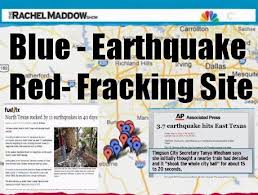
In recent weeks, the earthquake correlation has begun to worry me, for two reasons: first, the correlations are becoming both more numerous and obvious; but second, because the MSM is now piling in on the side of anti-fracking. When NBC starts having doubts about fracking, you know there might be a real problem – as opposed to just eco-hysteria. The following is a faithfully accurate summation of a CBS News report of September 4th 2013:
One of the most profitable areas for fracking lies over the geological formation known as the Marcellus Shale, which reaches deep underground from Ohio and West Virginia northeast into Pennsylvania and southern New York. The Marcellus Shale is rich in natural gas; geologists estimate it may contain up to 489 trillion cubic feet (13.8 trillion cubic meters) of natural gas, more than 440 times the amount New York State uses annually. Many of the rural communities living over the formation are jobless, and so understandably want to attract money from the energy industry.
Before January 2011, Youngstown, Ohio, which is located on the Marcellus Shale, had never experienced an earthquake since records began in 1776. However, in December 2010, the Northstar 1 injection well came online to pump wastewater from fracking projects in Pennsylvania into storage deep underground. In the year that followed, seismometers in and around Youngstown recorded 109 earthquakes, the strongest registering a magnitude-3.9 earthquake on Dec. 31, 2011. The well was shut down after the quake.
The new investigation of the Youngstown earthquakes, detailed in the July issue of the journal Geophysical Research Letters, reveals that their onset, end and even temporary dips in activity were apparently all tied to activity at the Northstar 1 well. For instance, the first earthquake recorded in Youngstown occurred 13 days after pumping began, and the tremors ceased shortly after the Ohio Department of Natural Resources shut down the well in December 2011. In addition, dips in earthquake activity lined up with Memorial Day, the Fourth of July, Labor Day, Thanksgiving and other times when injection at the well was temporarily stopped.
Now, as a chap schooled in spotting and measuring correlation, I am here to tell you that this evidence borders on the conclusive. At worst it is a red light telling the fracking apologists to STFU and hold off further progress or action until further evidence comes to light. Evidence, for instance, like the next case history.
Oklahoma’s insurance commissioner is urging citizens of the US state to buy earthquake cover as seismic activity there is expected to continue to increase in the wake of a boom in oil and gas drilling. The US Geological Survey (USGS) warned in a recent alert that people living in the central part of Oklahoma face an increased “earthquake hazard”.
According to the USGS, an average of 40 earthquakes per year occurred in Oklahoma from 2009 to 2013, up from an average of two to six annually between 1975 to 2008. The latter figures include a record-breaking 5.6 magnitude earthquake in November 2011 that destroyed 14 homes and damaged many more.
That is quite a jump in both incidence, severity, and correlation. Again, in most research circles you’d probably call that an 80+% correlation – ie, likely to be real….and again, a red light to say “Stop”.
Now examine with me if you will exactly why the frackers are so keen to cover up these facts, gloss over the dangers, and fire the sprint-gun as quickly as possible. Here are some factors to bear in mind:
1. Octopoid derricks have made fracking more efficient and offer better ROI numbers. They are also one of the prime suspects in the earthquake case: introduced relatively recently, here too we find a sudden leap in the number of earthquakes being recorded. It’s commonsense logic: if you drill laterally in eight directions as opposed to vertically in one, you will cause more subsidence. (Surveyors observing trees dangerously close to houses know that vertical root conifers pose little threat, whereas laterally rooted deciduous trees do.)
2. The other suspect is the water-blasting itself, which creates massive pressure underground, moves elements about, and leaves space where there wasn’t any before. With octopoids and high-pressure water consumption at massive levels, fracking will not deliver the oilcos anywhere near high enough returns to make the idea commercially worthwhile. It’s all about profit margins.
3. If you look at a graph of oil and gas drilling exploration after 1980, it’s very clear that the directors and their shareholders decided to take an investment holiday. Not only would this keep the price of energy high (as on the whole it has) it would also ensure massively reduced costs of sales…and – here we go again – deliver huge returns to the shareholders and directors.
The problem is, they took not so much a holiday as something akin to early retirement.
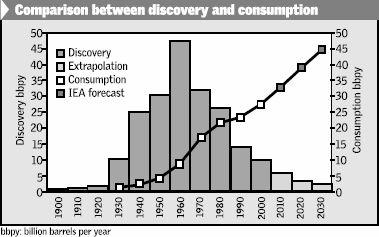 As the graph (left) shows, despite IEA forecasts of more drilling and expected consumption growth, actual discovery activity dropped by 80%.
Economists have been arguing for decades about which was the chicken and which the egg in this process, but that’s not relevant here. The point is very simply that the oil business senior execs and shareholders did incredibly well out of the policy, and that same policy is now an important reason why, 33 years on, the oilcos are desperate to sell fracking to the populace: most of the deep-water reserves that remain will cause a big drop in profit margins….and as the oil price isn’t going to shoot up during a global depression, the Texas Tea merchants face a grim future without said fracking.
4. In the UK, the situation is one involving more political considerations than in many places, but with business in there pushing things along at a wholly irresponsible rate. During the 1960s and 1970s, Labour squandered Britain’s North Sea bonanza on a combination of welfare splurges, inflationary wage bargaining, and huge Sovereign borrowing. The fact that, with all that free energy available, they wound up going cap in hand to the IMF in the end is a stain that the Party should never be allowed to forget. Mrs Thatcher, by contrast, simply allowed the oil barons (amongst whom her husband had been a notable profiteer) to let rip. I have for over thirty years now (on and off) for first professional and then blogging reasons been trying to tell folks that there is no real mystery in how oil profitability remains so high. The price is manipulated, and nearly all of it is at the refining stage – the accountancy of which is almost impenetrable, but always leaves the taste of scam in one’s mouth.
Now we find ourselves – after New Labour’s insanely uneconomic green-power bollocks – with an energy balance about as sensible as the economic imbalance which has been the legacy of Rightist Conservatism.
5. Last but by no means least, both here and in the States, the governments over time should’ve been throwing far more money at the development of post-oil locomotion technology. I don’t mean by this potty windmills and fart recycling, I mean a profound and creative look at what still seem to me the best bets: harnessing electromagnetic gravity forces (where the Israelis are miles ahead of anyone) and using a form of ‘solar’ energy to make fusion and electric cars more viable. The reason it took so long is easy: lobbying. There was never any way Ronald Reagan was going to threaten the oil industry whose money got him elected, any more than Thatcher was going to poo in Dennis’s den.
In conclusion, my thesis is this: we are about to assault the British Isles with the geographical equivalent of thalidomide, and the reasons are profits, shareholders, stock markets, oilco lobbying, and politically corrupt legislator incompetence that occurred in a past when the sun was shining, and nobody cared about the roof tiles coming off.
In Japan, meanwhile, the same thing plus nuclear industry lobbying are about to deliver the Japanese population a third Hiroshima….and perhaps even irradiate the world’s greatest athletes, because of economic and banking failure alongside a braindead OIC.
The British people need to wake up here. Not only are the water-usage projections of fracking damning for the UK: it’s now clear that the earthquake data are approaching smoking and lung cancer in terms of causality.
I repeat: we are being panic-herded into this ridiculously short-term solution to our energy problems. The Government isn’t listening, and the Opposition is muddled. We need a mass movement to pressurise the money-mad into submission.
But – and it’s a big but – what we don’t need – pleeeeeze – is thousands of hairy eco-warriors holding banners and sloganising. My central point remains that it isn’t economic activity that’s in the ecology dock here: it’s the economic culture that’s in the ethics dock. It’s about priorities, and doing the decent thing for our citizens…and for once, putting this ahead of shareholders and political opportunists.
Last night at The Slog: Dolfie und Eva & their cosy Windsor friendship
 The Slog