 Welcome to a new Slog feature, wherein the democratisation of journalistic feedback is celebrated. There follow some of the thoughts, theories, rumours and dramas that have been floating into Slogger’s Roost over the last 48 hours.

First up, an email from Boris Johnson’s office:
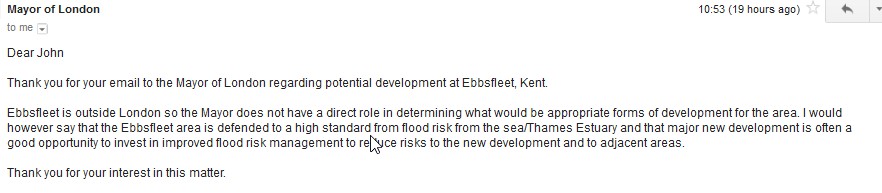 Cutting to the chase here, we get two bollocks in a banded-pack offer for the price of one: ‘Ebbsfleet is outside London so the Mayor does not have a direct role in determining what would be appropriate forms of development for the area. I would however say that the Ebbsfleet area is defended to a high standard from flood risk from the sea/Thames Estuary’.
One wonders in this case why the Mayor threw his very considerable weight (and millions in taxpayers’ money) at the personal proposal for an airport which (if I recall correctly) was going to be in the Thames Estuary. And while Ebbsfleet does indeed have huge 50″ bore anti-flood guns to the West, they are I’m afraid pointing in the wrong direction: the threat to Robsone Waterworld is from the sea (slight) and fenland seepage (huge).
Monitoring the casual corruption of Mayor Johnson is a fulltime occupation, so I’m more than delighted to give a plug to anyone dedicated (and mad) enough to undertake this leviathan task. Long-time BoJo prodder Dave Davies has just launched the www.cappi.org.uk website to try and expose what he calls “some of the improper conduct ref air pollution , including Bozo and Yeo’s little scam (under transport tab)”. Yes indeed Dave, most of Bo’s dealings are under the table. And not always involving merely money: the flesh is equally weak.
Moving along from those who whistle loudly the better not to hear, a Coop whistleblower with his lughole pinned very close to the ground alleges that Euan Sutherland didn’t resign over the governance issues as he made out. He was having an affair with his head of HR. She joined the Co-op around a year ago, and then left with a £1m pay-off all of a sudden. It was said her relationship with Sutherland had broken down. We ask ourselves if the esteemed members of the Treasury Select Committee will ask him about the role of indoor sports in the latter stages of his career. But more of us would be pleased by them pointing out how, as a chap playing the role of Clean Skin, he managed to be an Independent Non-Exec for two years on the Co-op Group Board whilst alsobeing the, um, Chief Executive of Kingfisher. Which is not a very independent role at a close competitor. Details, details. Get on with it.
Shell has just announced a huge reduction of its exposure to US shale gas development. It’s selling its leases on some 700,000 acres of shale gas lands in Texas, Pennsylvania, Colorado and Kansas. Those States, my friends, represent an area far bigger then the UK.
Over to you on that one, Dan. Let’s, maybe not, get fracking.
Yesterday at The Slog: The invisible robot armies of Ukraine’s Kharkov
(Stay tuned for an update on distraction from weapons in Ukraine).
EU rules on national bank resolution will not yet be in force, while the eurozone’s single resolution mechanism will be initiated only in 2015. So banks in northern Europe that are still backed by creditworthy governments would be treated differently than those in cash-strapped southern Europe: Germany can afford to bail out its banks; Italy cannot.
CommentsView/Create comment on this paragraphMore likely, the ECB will fudge the exercise, owing to fear of reigniting the financial crisis and pressure from national governments. Small countries will be singled out to make the exercise look tough, while bigger problems will be swept under the carpet: German banks have already succeeded in excluding many of their assets from the assessment.
CommentsView/Create comment on this paragraphOne argument for making the ECB the watchdog for eurozone banks was that it was less captured by the banks than national supervisors were. But its behavior throughout the crisis suggests otherwise. It has repeatedly prioritized the interests of banks in “core” countries and proved more pliable to political pressure from Berlin and Paris than from Madrid or Rome, let alone Dublin or Athens.
CommentsView/Create comment on this paragraphEven after the new banking union framework is fully in place, it will be full of holes. At Germany’s insistence, the ECB will supervise only the eurozone’s 130 or so biggest banks. That will leave the smaller Ländesbanks (state-owned regional banks), many of which made spectacularly bad lending decisions in the bubble years, and Sparkassen (smaller savings banks) in the hands of local politicians and Germany’s pliable financial supervisor.
CommentsView/Create comment on this paragraphThe argument that smaller lenders are not a systemic threat is spurious: consider Spain’s cajas. In any case, there will not be a level playing field.
EU rules on national bank resolution will not yet be in force, while the eurozone’s single resolution mechanism will be initiated only in 2015. So banks in northern Europe that are still backed by creditworthy governments would be treated differently than those in cash-strapped southern Europe: Germany can afford to bail out its banks; Italy cannot.
CommentsView/Create comment on this paragraphMore likely, the ECB will fudge the exercise, owing to fear of reigniting the financial crisis and pressure from national governments. Small countries will be singled out to make the exercise look tough, while bigger problems will be swept under the carpet: German banks have already succeeded in excluding many of their assets from the assessment.
CommentsView/Create comment on this paragraphOne argument for making the ECB the watchdog for eurozone banks was that it was less captured by the banks than national supervisors were. But its behavior throughout the crisis suggests otherwise. It has repeatedly prioritized the interests of banks in “core” countries and proved more pliable to political pressure from Berlin and Paris than from Madrid or Rome, let alone Dublin or Athens.
CommentsView/Create comment on this paragraphEven after the new banking union framework is fully in place, it will be full of holes. At Germany’s insistence, the ECB will supervise only the eurozone’s 130 or so biggest banks. That will leave the smaller Ländesbanks (state-owned regional banks), many of which made spectacularly bad lending decisions in the bubble years, and Sparkassen (smaller savings banks) in the hands of local politicians and Germany’s pliable financial supervisor.
CommentsView/Create comment on this paragraphThe argument that smaller lenders are not a systemic threat is spurious: consider Spain’s cajas. In any case, there will not be a level playing field.
View/Create comment on this paragraphBut EU rules on national bank resolution will not yet be in force, while the eurozone’s single resolution mechanism will be initiated only in 2015. So banks in northern Europe that are still backed by creditworthy governments would be treated differently than those in cash-strapped southern Europe: Germany can afford to bail out its banks; Italy cannot.
CommentsView/Create comment on this paragraphMore likely, the ECB will fudge the exercise, owing to fear of reigniting the financial crisis and pressure from national governments. Small countries will be singled out to make the exercise look tough, while bigger problems will be swept under the carpet: German banks have already succeeded in excluding many of their assets from the assessment.
CommentsView/Create comment on this paragraphOne argument for making the ECB the watchdog for eurozone banks was that it was less captured by the banks than national supervisors were. But its behavior throughout the crisis suggests otherwise. It has repeatedly prioritized the interests of banks in “core” countries and proved more pliable to political pressure from Berlin and Paris than from Madrid or Rome, let alone Dublin or Athens.
View/Create comment on this paragraphBut EU rules on national bank resolution will not yet be in force, while the eurozone’s single resolution mechanism will be initiated only in 2015. So banks in northern Europe that are still backed by creditworthy governments would be treated differently than those in cash-strapped southern Europe: Germany can afford to bail out its banks; Italy cannot.
CommentsView/Create comment on this paragraphMore likely, the ECB will fudge the exercise, owing to fear of reigniting the financial crisis and pressure from national governments. Small countries will be singled out to make the exercise look tough, while bigger problems will be swept under the carpet: German banks have already succeeded in excluding many of their assets from the assessment.
CommentsView/Create comment on this paragraphOne argument for making the ECB the watchdog for eurozone banks was that it was less captured by the banks than national supervisors were. But its behavior throughout the crisis suggests otherwise. It has repeatedly prioritized the interests of banks in “core” countries and proved more pliable to political pressure from Berlin and Paris than from Madrid or Rome, let alone Dublin or Athens.
 The Slog