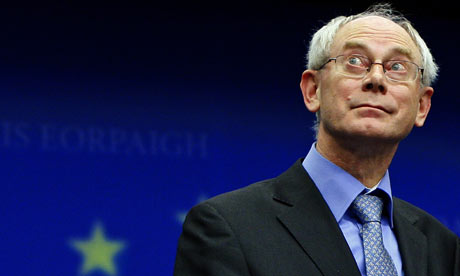
 Van Rompuy….piece of squidgy cake in our time
As Greece’s political monsoon ends, the EU gives Athens an umbrella.
OK, focus now, because I’m only going to write this once.
Greece has had slightly over 20% of its bank-lender debts forgiven. Technically, when the papers are signed on this, it will be in default. Over the last year, Greece has run up its own backside taxing citizens and slashing benefits to avoid this very outcome, because the Athens government was told by the Sprouts it MUST NOT default. Now (under German insistence) it has defaulted anyway.
20% of Greece’s debt is about $70 billion. Had that much of the debt been forgiven six months ago, when I first suggested it, there would’ve been no riots, no knife-edge Parliamentary votes, and a much lower spike in global debt yields.
Greece was also told by the Sprouts and the IMF that it MUST AT ALL COSTS sell all the family silver, all its infrastructure and all its publicly-owned businesses. All those concerned – the IMF, the ECB, Brussels, Merkel, and yes, even Sarkozy – said they wouldn’t get any more money until they passed a law guaranteeing to do that. I said at the time there would be no market for these assets, and Greece was being asked to flog the only card it had in its hand: the potential to get the economy going again.
As part of yesterday’s package, says the BBC (and most other media agree with it) ‘Greece’s bail-out will be complemented by what was billed as a “Marshall plan” to boost the economy of the recession-mired country….EU development funds and loans from the European Investment Bank would be used to finance Greek infrastructure and development projects.’
Although the media releases, self-congratulatory press conference, and general atmosphere of trebles all round suggested that, in terms of lender haircuts, this is a done deal, it isn’t. Not a single bank has as yet signed a single piece of paper. The lenders are to be given 4 (that’s four, count them) options as to how they participate. These debt swaps and rollovers come in 15-30 year packages at lower rates than currently, some of which also vary between options. There is thus no way of knowing in advance how big the ‘haircut’ will be. There are these four ways to contribute because as well as being unable to offer the Troika any real relief, they squabbled amongst themselves – and eventually ran out of time. (Free-market capitalism, you see, is all about giving the customer choice).
My informed guess is that the lenders will wriggle out of as many obligations as they can, and probably try to avoid making anything obligatory – as indeed, EU banking law insists they must. So within a few months we will be back in the pits again, working hard with another wheelbrace.
But penultimately, fear not – for the Bigwigs have commanded that there will be no contagion. Each politico in turn insisted last night that this is a one-off deal, and will never be done again. In fact, they specifically said that no other peripheral debtor will get this ‘unique’ opportunity to sort itself out, thanks to their financial largesse and jolly hard work to bring this never-to-be repeated offer to fruition.
All of which will raise eyebrows on every market in the world, once the dust settles. Because they have just been told that Portugal and Ireland will have to look after themselves, otherwise it’ll be finito Benito. “Greece is in a uniquely grave situation in the Euro area,” the eurozone princelings announced, “this is the reason why it requires an exceptional solution.” And in case anyone had nodded off, Sarkozy said there will be no imposition of losses on private sector lenders to the Irish Republic or Portugal.
Not mentioned, however, were Spain and Italy. So perhaps this deal is sort of fairly unique. Squared circles and partial uniqueness are everyday miracles in the EU.
And just as bad, there will now be some serious argey-bargey as to whether the debt restructuring triggers payouts on billions of dollars in credit derivative contracts, and some hefty payouts on client insolvency insurance.
I don’t know what ruined my night’s sleep more: the sight of Herman Van Pompuy’s impression of Neville Chamberlain in 1938, or the sound of Christine Lagarde talking over the Newsnight anchor busy trying to explain to the orange bat what a crock this whole deal is. Lagarde in particular is that greatest of all dangers, an idiot with a brain.
I’ve been scanning the financial press and broadsheet business sites this morning so far. All of them report the outcome verbatim. Only Damien Reece seems to have a steer on what’s really happened so far. Our mainstream media remain, on the whole, waiters at the tables of power they have so obviously been serving for the last twenty years.
Related: Why the Greek asset sales are irrelevant
How 6 weeks later, we’re where we were on June 5th
 The Slog