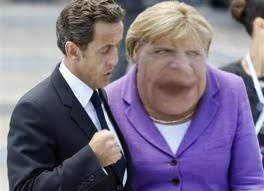
 “I sink zey are onto us, mein kleiner Poodle”
Slog’s Bankfurt mole offers blunt critique of Merkozy deal
As of midday GMT Monday, serious cracks are beginning to appear in the last Thursday’s Brussels Accord. French Parti Socialiste candidate Francois Hollande has already said he will renegotiate the deal, the markets are displaying little enthusiasm for it, and the anti-commitment movement within Germany itself was given a boost yesterday when both bankers and judges poured cold water on the proposed plan.
Le Figaro this morning quotes PS Presidential candidate Francois Hollande as saying, “The agreement is only vaguely in place for approval in March. If elected, I will of course renegotiate it to put in there what it lacks: a degree of control over the markets, and a clearer set of reassurances for them…such as eurobonds, ECB intervention and so on. Also I will with [the legislature] instigate a strict programme to restore our public finances”.
It’s election politics, of course – but very skillfully done. Hollande is effectively saying that President Sarkozy has given in to Germany, but the markets need both more control and more reassurance. He has gone right to the heart of why Sarkozy’s deal looks bad, and how both the President and his Economics Minister Christine Lagarde (now boss of the IMF) screwed up the nation’s fiscal control.
Today, both the FTSE and Wall Street futures are down, Moody’s says its imminent review of European sovereigns looks set to be negative, because no substantive measures came out of last Thursday’s EU summit. The euro has fallen below $1.33, and trading in Italian cash products is poor: the yield on Italian 10-year paper was up 41 basis points to 6.73% at midday.
Perhaps most significantly, The Slog’s Bankfurt Maulwurf has (predictably) weighed in heavily against the Merkozy deal.
“Frau Merkel is not looking ahead beyond her nose,” he began, “and this feeling I can tell you is gaining ground among my colleagues. I suspect even [Finance Minister] Schauble now has great reservations. This European money to boost the ESM….who is left than can afford to pay for such a thing? There will be a serious revolt if the [European] Central Bank is pressurised into anything irregular. Who knows which way Draghi will jump?”
His words seemed prescient in the light of reported remarks by Andreas Dombret, a Bundesbank big-wig, who seems to have firmly rejected any German central bank involvement in what he called “the covert funding” of EMU states in trouble by using the IMF. Herr Dombret went further, dubbing the Bundesbank’s share of any IMF package “inherently risky”. It would also break through the agreed €211bn bailout ceiling already agreed last month in the Bundestag.
As predicted recently on several occasions in these columns, there remains enormous reticence about Merkel’s fiscal union ambitions in Parliament, the banking sector and the judiciary of her home country. Bundestag president Lammert recently insisted that the summit package ‘should undergo scrutiny by Germany’s constitutional court, warning that new powers for European commissars to intrude in national budgets might conflict with German fiscal sovereignty’. (See excellent piece in today’s Telegraph by Ambrose Evans-Pritchard, in which he adds that Washington too is lukewarm about the IMF role per se.)
But the Bankfurt Mole reserved severe criticism for David Cameron too.
“In my opinion he has handed Frau Merkel the patriotic card to play, ” he said, adding, “Many people in German business and politics are disappointed by the British Coalition’s arms-length approach over the last year. In our view they could have acted as a steadying influence. But now many Germans have come to see Britain as uncommitted and selfish. This has allowed President Sarkozy to push things in his favour. David Cameron was foolish to fall into the trap. Now [Merkel] has more ordinary Germans on her side.”
Many in Britain would take issue with that analysis, but the point being made in this piece is a simple one: there are many stakeholders in this deal, and most of them don’t seem to be up for it. Further, in promising IMF, EU sovereign contributions, and ECB help, the Merkozy tendency is way ahead of itself.
This has all the makings of yet another dud. The markets are unlikely to be merciful.
Previously on this subject: Geithner privately nervous about Merkozy Accord.
 The Slog