I’d like to start tonight by recording two completely different events two continents apart.
It’s official: China is now the largest trading nation by volume and value in the world.The news report I read was in The Guardian: “China’s annual trade in goods passed the $4tn (£2.4tn) mark for the first time last year according to official data, after exports from the world’s second largest economy rose 7.9% to $2.21tn and imports rose 7.3% to $1.95tn. The US is yet to publish its 2013 trade figures, but with trade totaling $3.5tn in the first 11 months of the year, it is unlikely to beat China.”
Wull, it wuz inevitable wonnit? I’m not so sure myself.
Driving past a small town close to my place here in France, I noticed a new petrol station had opened. It is fully automated and works only with credit or debit cards. At my nearest supermarket, customer checkouts now outnumber those manned by staff, and the car wash is also fully automatic. While in Britain over New Year, I was struck by how many more shops had closed down, and been replaced by charity shops run by older people, often on a volunteer (unpaid) basis. Around the world, banking and utility call centres are being replaced by online automation. And right across the developed world, jobs are being moved to Asia, Africa and South America in search of lower and lower costs.
What connects these two events? Nothing more or less than the globalist neoliberal economic model. It is destroying our culture, and handing economic victory to the Chinese. Here’s why.
Faster than the ailing Western economies can create new jobs, neoliberal Bourse-led economics, financial mismanagement, the internet, mechanisation and accountants are destroying the old ones.
During 2011-12, 35 big U.S.-based multinational companies added jobs much faster than other U.S. employers, but nearly 75% of those jobs were overseas. During that period, America’s new job creation rate was just 3.1%. The larger globalised US sector as a whole cut its workforce in the U.S. by 2.9 million during the 2000s decade, while increasing employment overseas by 2.4 million, 2011 data from the U.S. Commerce Department showed. This graph from Commerce says it all quite neatly:
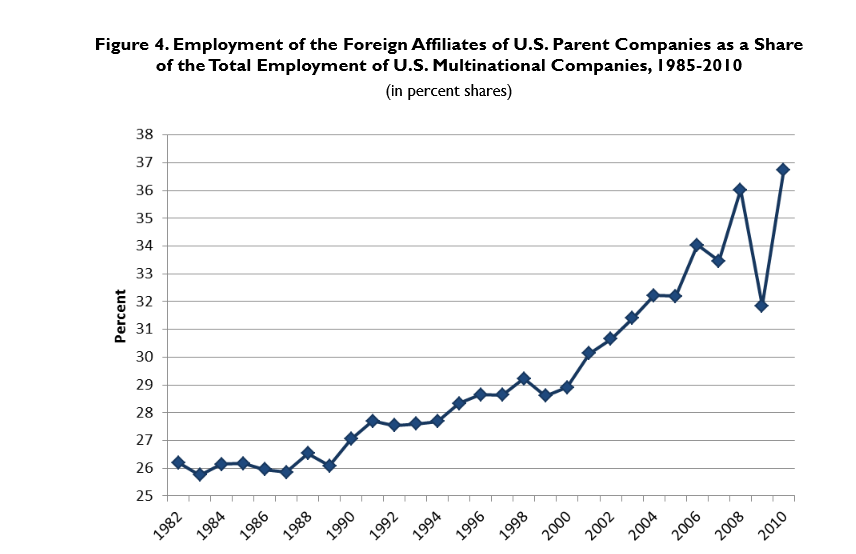 There is, of course, a massive problem down the road with doing this: cutting costs in the home market means cutting salaries and jobs, which reduces personal disposable income, which in turn reduces consumption….but on top of that, makes the poorer squeezed middle turn to choosing the cheaper imported product. There is only one possible result of that process: a growing trade deficit.
But globalist neoliberal business and banking don’t do consequences: they do 25% on the gross year in year out, happy shareholders and higher share prices. That way, everyone in the 3% comes out on top. But 97% (infant school maths would suggest) don’t. And once the banks start screwing up, they “have to” be bailed out…which puts the National Debt up.
This is a system to which the Friedmanite fanatics say there is no alternative. I sure as sh*t hope there is. And I’m sure there is…if the People will just wake up.
Technology as a factor is is exacerbating things, but the neolibs embrace it with ravish in mind. Astonishingly, money.cnn showed that in 2008 alone, 2.6m US jobs were lost largely to mechanisation and internet automation in service, manufacturing and mining industries. We hear a lot about non-farm payrolls in the States, but mechanised cropping threatens another 2.4 million jobs in agriculture. And we’re not just talking farm workers here, but also owners: Bovine Growth Hormone (BGH) is a naturally occurring hormone that stimulates the production of milk in cows. Scientists have successfully isolated the key growth-stimulating gene and cloned industrial portions in the laboratory. The genetically engineered growth hormone is then injected back into the cow, forcing the animal to produce between 10 and 20 percent more milk. A study conducted several years ago predicted that within three years of the introduction of BGH into the marketplace, upwards of one-third of all remaining US dairy farmers may be forced out of business because of overproduction, falling prices, and dwindling consumer demand. (We’re already seeing this in Britain)
The banking crisis of 2008 hit Britain harder than most places, because we had allowed our dependence on banking services to become ridiculously high. The banking sector as a whole lies through its teeth about the British taxpayer making money when the banks are bought back, and the all up cost having been reduced over time. Almost all of this is pernicious drivel, and they know it: the problem with British banks is the responsibilities and commitments we’ve had to take on while they keep on awarding themselves massive bonuses.
The best way to settle this never-ending issue about which clowns like David Buik sermpnise is to listen to that which emerges from the horse’s mouth, not the horse’s arse: in a July 2011 report on the treasury’s “financial stability interventions” by the end of the 2010-11 financial year, the Treasury set out the total cash spent, guarantees made and fees received from the banks so far. It concluded that since 2007, the UK had committed to spending £1.162 trillion at various points on bailing out the banks. That is almost exactly half the stated National Debt.
Since then, the Bank of England has been gaily chucking over £400bn per annum at the problem with easy QE money. In the US, the Fed Reserve’s all-up cost, as I posted yesterday, is infinitely more frightening.
The simple fact remains that, as a result of the completely self-inflicted mess created by globalised banking and its idiotic derivative/lending/overleveraging models, we have seen austerity in Europe, unemployment, and cuts to social welfare….all of which are bound to depress consumption and economic growth.
…………………………….
If you haven’t yet discerned what my problem is with the current capitalist model, then let me spell it out: whichever way things turn, neoliberalism winds up cutting its own throat. It insists that consumption-led growth is the only approach, but then realises that its greed is getting in the way of that – and so it turns to poorly monitored lending to make credit get it out of a hole. And when it doesn’t, in come the accountants and cut the costs. Which exacerbates the situation further, shortly after which the banks’ credit madness bites them in the bum, and the taxpayers get raped yet again to pay for it….which further reduces their consuming power…andonandonandonandon.
For the nth time, I am not taking a political position here: my objection to neoliberalist greed-based economics is social and commercial. It simply doesn’t deliver on either dimension. It doesn’t even mirror our development as a pack species.
These are the flaws: volume obsession, untargeted credit, globalist mercantile fantasies, bourse demands, remote shareholders, underinvestment, investment banking’s dislocation from the economic common good, reliance on eternal consumption, and the crazy idea that responsibility to the shareholders comes before the stability and contentment of mutually dependent communities.
In 1937, Doktor Goebbels the Nazi propaganda minister made a speech in which he made the following ridiculous claim:
“Our enemies here in the Reich are Jews and Communists, because all Jews are Communists”. That must’ve made the Rothschild family smile.
Today, the apologists for our dyfunctional version of capitalism are saying and writing rubbish of the same high quality. And yet, all the emerging signs since the start of the year suggest that they don’t believe a damned word of it.
I will be writing about that tomorrow. Sleep tight.
Earlier at The Slog: Cops kick the BBC as Elm House Caligulas stay on slow burn
 The Slog